What makes GPL better than BSD licensing is that it is a kind of militant democracy.
Positive Freedom Beats Negative Freedom #
Adapting the concept of militant democracy (Wehrhafte Demokratie), GPL is a secret formula for protecting the free software movement so it can continue for the long term.
Therefore, software development should use GPL to preserve the spirit of freedom and carry through the free spirit of Copyleft, rather than permissive terms such as BSD, MIT, and Apache. If you are going to use this kind of license that is almost no different from releasing copyright into the Public Domain, you might as well just use WTFPL and be done with it!
We should talk more about Free Software rather than Open Source. GPL does not restrict the freedom; instead, it protects the freedom!
Although both are open source operating systems, where BSD systems fall short compared with GNU/Linux systems is that they lack the spirit of the GPL. Without this moral appeal, the power of the whole community is weakened, becoming pure volunteer labor and a system that lets others take whatever they want.
To put it harshly, the BSD License is basically a “Cuck License,” a cuckold clause. The GPL license is: I let you ride my wife, but your husband also has to let me ride him. The BSD license is: you voluntarily let your wife get ridden by others, receive nothing in return, and still think it is fine!
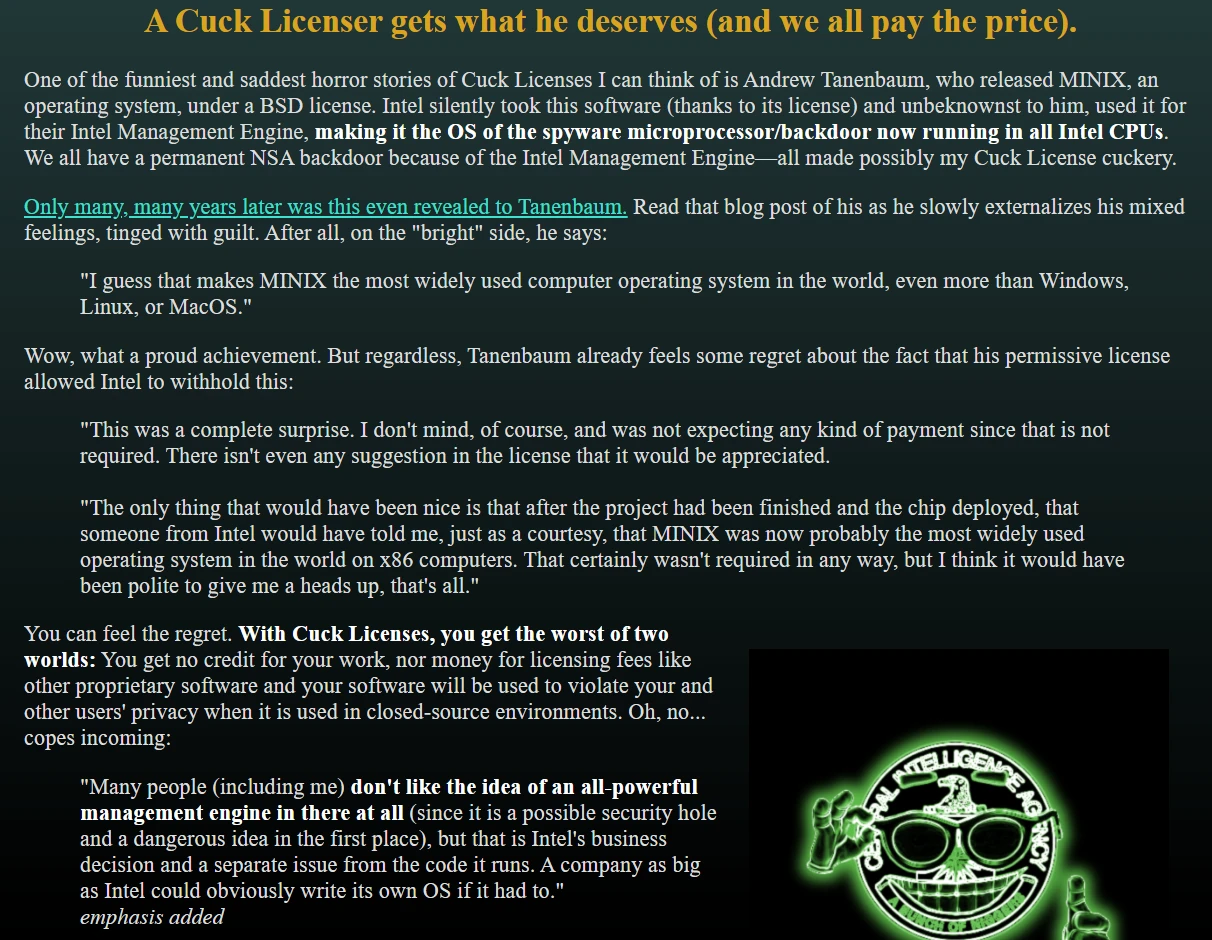
An image describing the consequences of the Cuck License. The rough idea is that the professor who originally developed Minix released it under a BSD license with the attitude of doing good, never expecting Intel to take it and make Intel ME, a massive surveillance software at the CPU low-level.
The hacker community alone is not a powerful enough weapon against the capital of large corporations. It also needs the guidance of the free software movement to protect software freedom. Compared with BSD license terms, GPL can guarantee the healthy future development of software, meaning that after software opens its source code, it must provide equal contribution back, preventing the software from being easily monopolized. GPL itself is unfriendly to existing business models, and the name “free software” is also not as business-friendly as the name “open source software.”
This is built on a high-risk gamble: only if the first company is willing to invest in this rule and spiritually identify with the spirit of GPL can it possibly succeed and develop a complete ecosystem. At present, Linux’s great gamble back then seems to have succeeded. Companies really are willing to support Linux development, with RedHat as a typical example.
Although many companies are now trying to technically bypass GPL, stealing or parasitizing the achievements of the Linux Kernel to develop their own closed-source products, the impact brought by GPL is still enormous, ensuring that the center of Linux is forever free and open source.
The relationship between GNU and Linux should be closer. That is what makes a free operating system. But the current problem is that some projects only seize Linux development results, then use them to make closed-source products, only putting on a surface-level open source appearance to deceive people into trust.
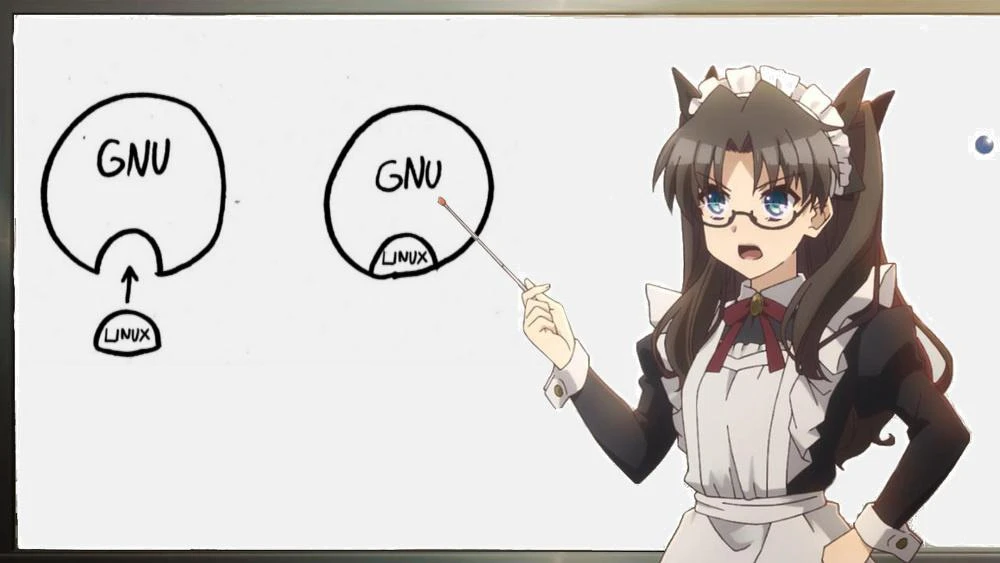
However, it is a bit of a pity that Linus refuses to adopt RMS’s opinion and upgrade the Linux Kernel from GPLv2 to GPLv3. Linus is a pragmatist. What he ensures is negative freedom, only emphasizing the practice of open source contribution back, but he is unwilling to add terms that prevent large corporations from exploiting loopholes and turning it into closed-source products. Part of the reason is also that Linux has already developed maturely and become a worldwide commercial project involving too many interests, so perhaps it is better not to change it.
But, “Those who would give up essential liberty to purchase a little temporary safety deserve neither liberty nor safety.”