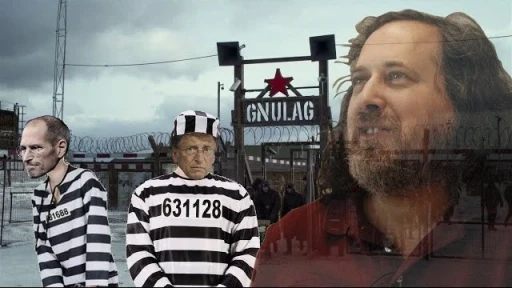
Linux Has Become Too Mainstream, So I Considered Switching to BSD or Systems That Follow the Unix Philosophy.
Linux vs BSD for desktop, which one?
Lady Suwako told me that Linux has become too “mainstream”, so should I switch to a BSD system to inherit the Unix spirit? For the past week, this thought has kept appearing. After comparing Linux with BSD (or systems that follow the Unix philosophy), I kept wanting to switch over.
While writing this article, I felt that my digging into these rabbit holes had gone a bit too far.
Life is a well of delight; but where the rabble also drink, there all fountains are poisoned.
The Systemd Controversy: Once Again Standing in the Eye of the Storm #
When Systemd first appeared in 2010, it was heavily criticized by the Linux community. It was merely an init system, yet it tried to cover everything. But time has passed, and now it has become the common standard of mainstream Linux distributions, almost an indispensable system management tool.
Systemd has made everything too complicated, and the spirit of traditional Unix philosophy is disappearing. Systemd’s design affects every aspect of Linux, permeating major distributions and influencing developers’ future decisions. We, domesticated by modern technology, can no longer understand the principles by which operating systems work. Switching to a system without Systemd seems necessary.
Recently, in order to cater to age verification bills being promoted by U.S. states, Systemd developers added an OS-level age verification mechanism: userdb: add birthDate field to JSON user records#40954 This PR was quickly approved by Lennart Poettering and others, and they refused to revert it. Presumably Systemd 261 will officially include this feature.
This caused people’s grievances against Systemd to erupt again. Although Systemd’s age verification field is not mandatory and merely provides a field for other programs to access, some users with extreme pursuits of freedom and privacy believe this is the beginning of mass surveillance. The system’s low level fundamentally should not store sensitive data about user identity, and some people are extremely disgusted by public authority intervening in the issue of “os-level age verification.” Systemd manages too much, replacing many system services and violating the Unix philosophy. Now, it is aligning with the interests of large companies and governments. People are forced to swallow it, because Systemd is already the common standard of all major Linux distributions, and upstream changes quietly affect everyone downstream. Anyway, whatever function upstream wants to add, Systemd developers have the final decision-making power. What, you are not convinced?
Governments and corporations always love squeezing people’s freedom. When commercial companies develop software, they seem to like rushing to push new technologies and force everyone to swallow them. This is called Agile development or whatever. They only pursue 90% usability, not 100% stability. Anyway, after release, they keep iterating, exhausting users, and thereby achieve their goal of monopolizing the final right of interpretation. Then, in order to respond to commercial competitiveness and cater to so-called trends, they often make technical changes without regard for user experience, and so individual freedom is sacrificed. Users who have come into contact with the free software movement will surely be dissatisfied with this phenomenon.
Not all corporations, but always corporation. (Not all men, but always man.) Open source looks like the product of ideals, but it also requires financial support. Talking about “open source” software is more likely to invite corporate involvement than insisting on the name “free” software. As long as users are given enough convenience, or are brainwashed into believing this is best for them, they will trade freedom for everything.
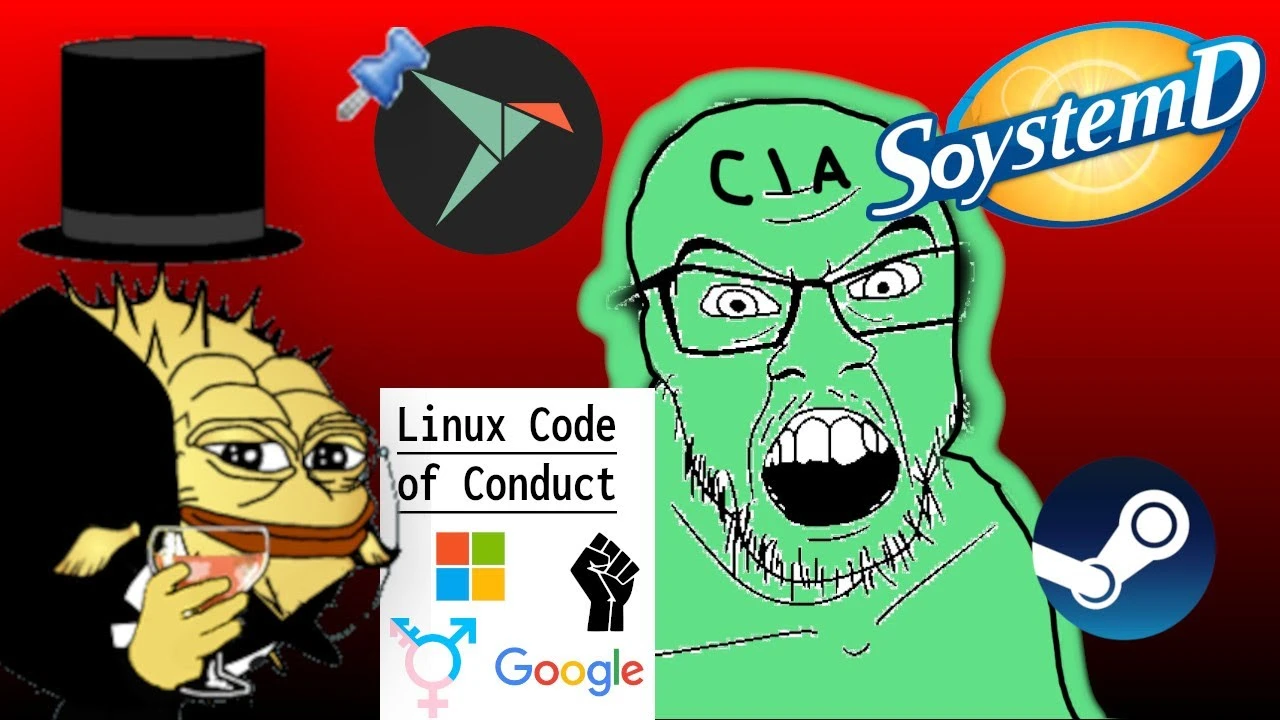
Github, like Pixiv, has long since stopped being simply a place to share works. It is a place to display your resume, a training ground for people to obtain money. Some projects gradually gain attention, usually meaning they are noticed by companies, and then begin to receive funding. As contributors increase, open source projects inevitably have to cater to the needs of corporate owners in their development. For example, the development of Linux Desktop is largely led by RedHat. The standards they promote drift between enterprise servers and desktop users, while also selling their own solutions. Now everything has to be a container, departing from the traditional package manager packaging model. RedHat deserves much credit for this. They say this is the direction the future should take. Therefore, the hacker spirit of the 1980s is gone forever. Only in some corners of the internet are there still people developing software that grows autonomously without corporate interference, such as the suckless community. But it is hard for them to succeed, and users themselves need extremely strong geek power to use them well. Corporate development needs are far more important than decentralized communities shaped by groups of hackers, and they are also easier for the public to accept and achieve commercial success.
Other open source projects are like this too, such as Android and ChromiumOS. They were originally projects initiated with corporate involvement, invested in to shape an image of open social responsibility, while in reality quietly exerting controlling influence. Then they unconsciously promote Enshittification.
Under the influence of large companies, Linux will sooner or later become a monster like Windows and macOS. To exaggerate, cooperation between tech companies and governments, and their oppression of people’s freedoms and rights, will bring the world into dystopia in the near future.
Fortunately, the power of free software still gives people choices.
This Batch Is Pure: Systems That Follow the Unix Philosophy #
I like looking for blogs that share Linux usage experiences. There is more and more Chinese content now, which is a good thing. Most of it talks about Ubuntu, Arch, Fedora, and the like. Many are desktop users, not server operations and maintenance content. It seems Linux can gradually become a daily system on equal footing with Windows.
But if you search for Linux distributions that are more niche and do not follow trends, it is easy to find some magical websites. For example: users of anti-Systemd Linux distributions.
When searching for information on Artix and Devuan, I found SOULMINIGRIG, which is actually a multilingual Chinese blog mainly in Japanese. 目前的伺服器環境以及什麼樣的文章會讓人想閱讀? mentions some experiences using Artix and Devuan, and the author also collects a large number of ThinkPads. Truly precious.
Through SOULMINIGRIG’s blog I then found: Technical Suwako. They look like an interesting person too, except they also seem to be another right-wing figure.
【デジタル自主】LinuxからOpenBSDに乗り換えた理由 In it, he wrote about the reasons for switching from Linux to OpenBSD.
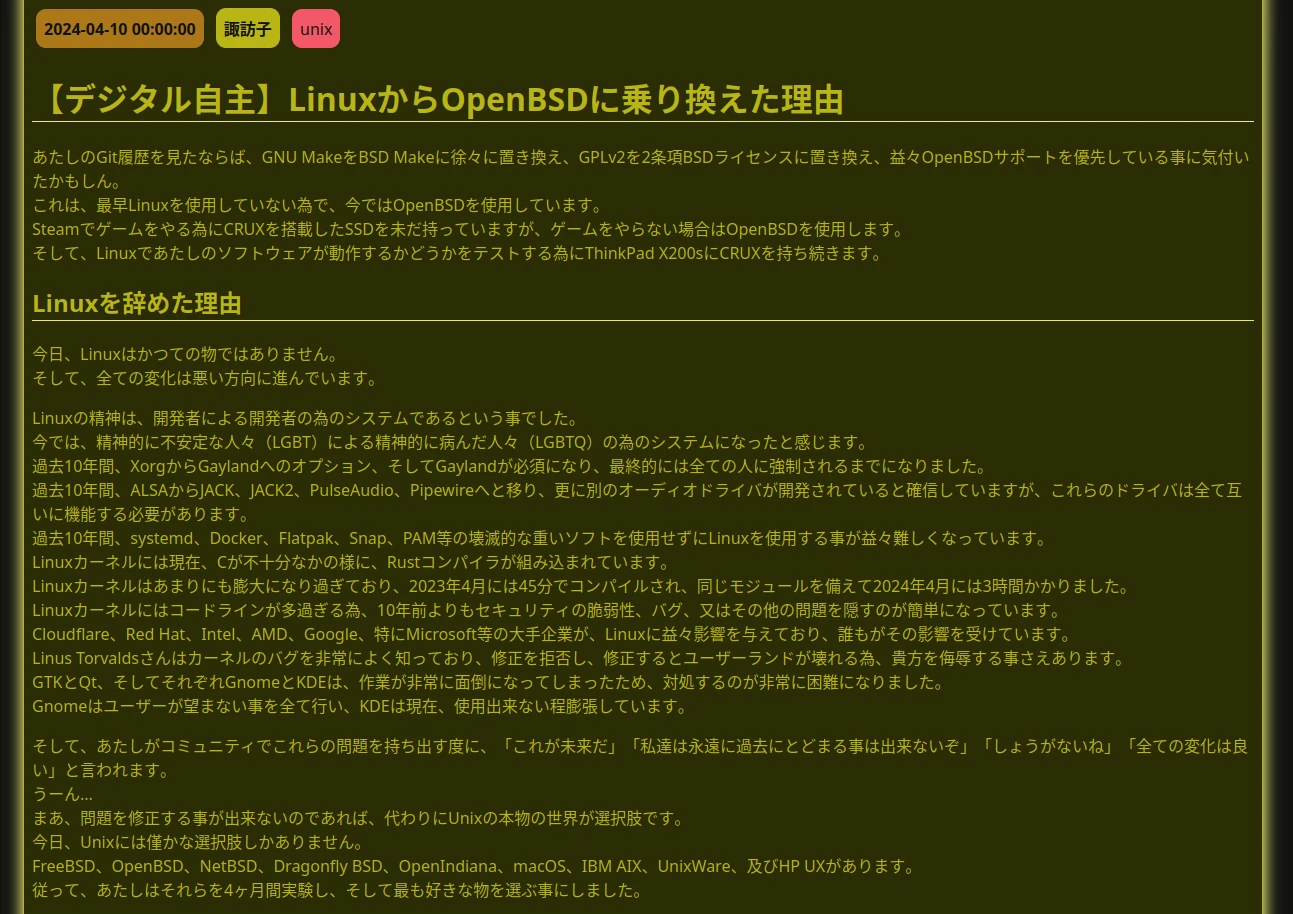
Anyone who writes Wayland as Gayland is absolutely no ordinary person. Uwa uwa, forbidden, forbidden. This can easily be reported as hate speech by leftist assholes. Has he watched too much 4chan /g/? Or has Bryan Lundukee’s group started exerting influence?
He believes Linux is now led by a group of mentally ill people serving LGBT mental patients, and is no longer developer-centered, so one needs to switch to BSD to have the Unix spirit. Systemd, Flatpak, and Docker pushed by large companies are too bloated and centralized, forcing everyone to swallow them. This is a terrible development direction.
The author also attacks the United Nations SDGs in other articles as a leftist conspiracy.
Sometimes I feel that if you deeply study Linux hacker culture, it is easy to step into some autistic domain.
There are many KOLs who study Linux. Videos by Bryan Lundukee should really be watched less: highly politicized, joking-style discussion of tech issues. He can be said to be a unique existence among Linux Youtubers. Yet I cannot help clicking XD… If you treat it as a clown Talk Show, fine, but you cannot actually believe what he says. Look at the comments under his Substack and Youtube. It is basically a large-scale team-building site for 4chan /g/ users.
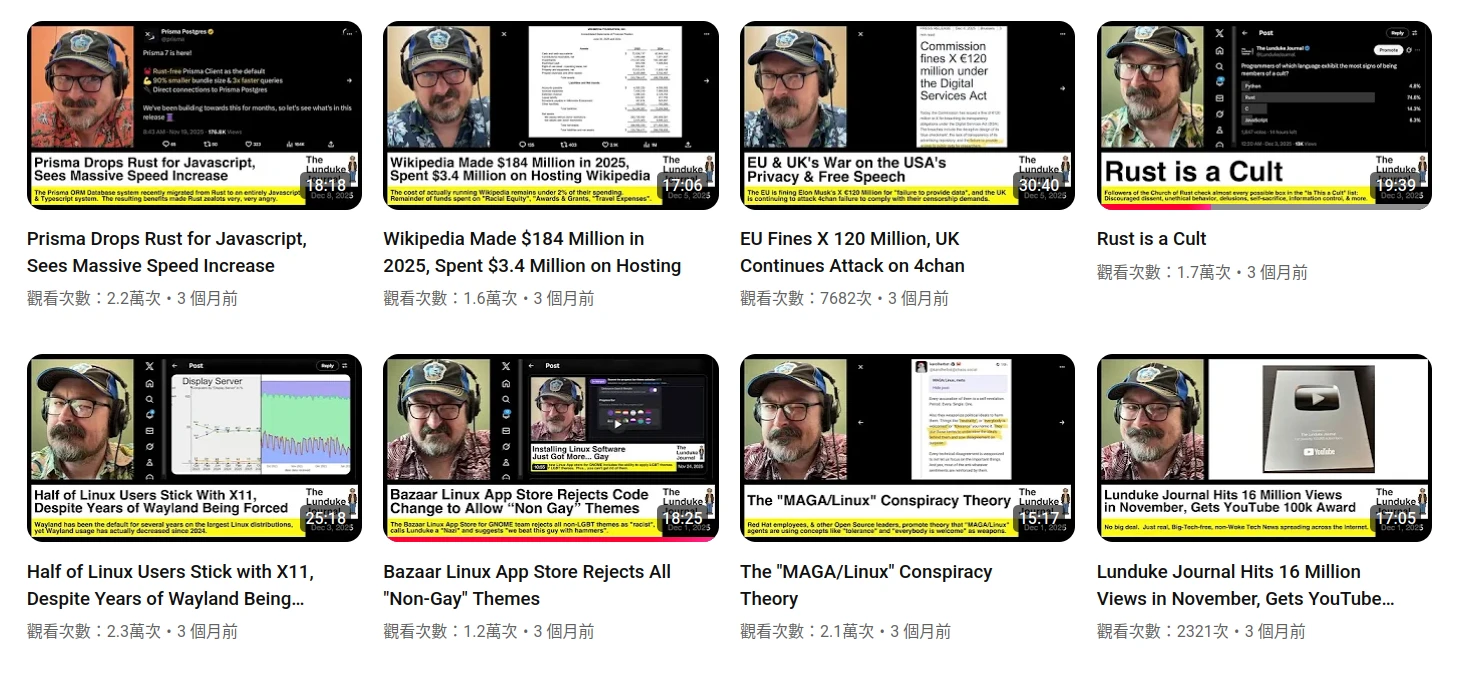
Listen too much and it really forms a QAnon-style conspiracy worldview. Any small drama in the FOSS circle can be made into a 10-minute video rant, and then he steers the narrative toward a right-wing interpretation.
Do you know what the D in Systemd means? It is SystemDEI. Since you oppose political correctness polluting games and movies, you should also resist Systemd polluting Linux’s traditional values!
In their view, everything promoted by large companies like RedHat is wrong, all of it is spreading left-wing woke values. Wayland is derogatorily called Gayland, and Systemd is called SystemDEI. They often cite Microsoft’s Embrace, extend, and extinguish strategy to explain the actions of Linux tech companies. Code Of Conduct is a leftist conspiracy used to clamp down on people’s thoughts and freedom of speech. Any activity that promotes LGBT issues even a little is destroying right-wing traditional values. Now Rust is used everywhere to develop or rewrite existing software, which is using progressivism to “corrupt people’s hearts”; we should not trust this emerging technology.
For Lunduke, only those non woke software projects that are more conservative toward technical change are software that respects users. In short, the viewpoints in his videos are too much even for me, someone who leans Trump supporter. The funny thing is that because Bryan Lundukee is Jewish, on 4chan people make Holocaust-in-hell meme mockery of him.
How does that saying go? American leftists are hypocrites, and right-wingers are lunatics. If you look for some anti-Systemd Linux KOLs, besides Bryan Lundukee there is Sam Bent, as well as the webmaster of Homo Ludditus. Most of them pursue the traditional Unix spirit, lean toward BSD style, and cannot stand what RedHat has done to Linux. Big companies are bad. Unfortunately, these people who pursue personal freedom by name very easily fall into the predicament of conspiracy theories. Content attacking Systemd can easily go off course, drag in politics, and go from corporate hegemonic culture to deep state conspiracies and so on. I think you can only practice what you preach like Luke Smith, live in the wilderness and film videos, to stay away from all disputes in the civilized world.
The mainstream Linux world is too “left”, and so the other side appears too “right.”
Pragmatically Searching for Traces of Unix Philosophy: Unix-Like Linux Distributions #
Linux and BSD are both systems with a long history. They initially began in the 1980s, were more or less influenced by Unix, and then produced various distributions. Hackers from GNU and the free software movement exerted influence among them, preserving part of the hacker spirit of the 1980s. Therefore, we should seek systems that retain this spirit.
What is Unix philosophy? Unix philosophy is a set of principles formulated by some hacker pioneers in the late 1970s. It is still regarded by some people as classic today, even worshiped like a religion.
There are many systems that follow the Unix philosophy, among which BSD is the largest group. Linux can only be considered a Unix-like system, while BSD can be said to be the system closest to Unix philosophy. However, today the Unix trademark requires paid certification; otherwise, one can only be called Unix-like. Currently only Apple’s macOS has passed certification, so it can call itself Unix. But we also know that Apple is no longer the cool company that opposed Microsoft in the 1990s. It is just another capitalist establishment giant. Seen this way, Linux and BSD systems that insist on source code freedom and openness are better choices.
Compared with Linux, BSD systems have far fewer distributions. The main versions are GhostBSD, MidnightBSD, OpenBSD, FreeBSD, NetBSD, DragonflyBSD, and so on. Their system design structures are relatively unified and not as chaotic as Linux. System design is very stable, continuously improving existing technologies rather than constantly inventing new things, and the acceptance of new technologies is more conservative.
From a practical perspective, switching from Linux to BSD requires great resolve and will encounter many driver support problems. According to my previous actual experience installing FreeBSD (see: Install FreeBSD), you will be constrained by many modern Linux “conveniences” and then feel that BSD system design is too primitive and hard to use.
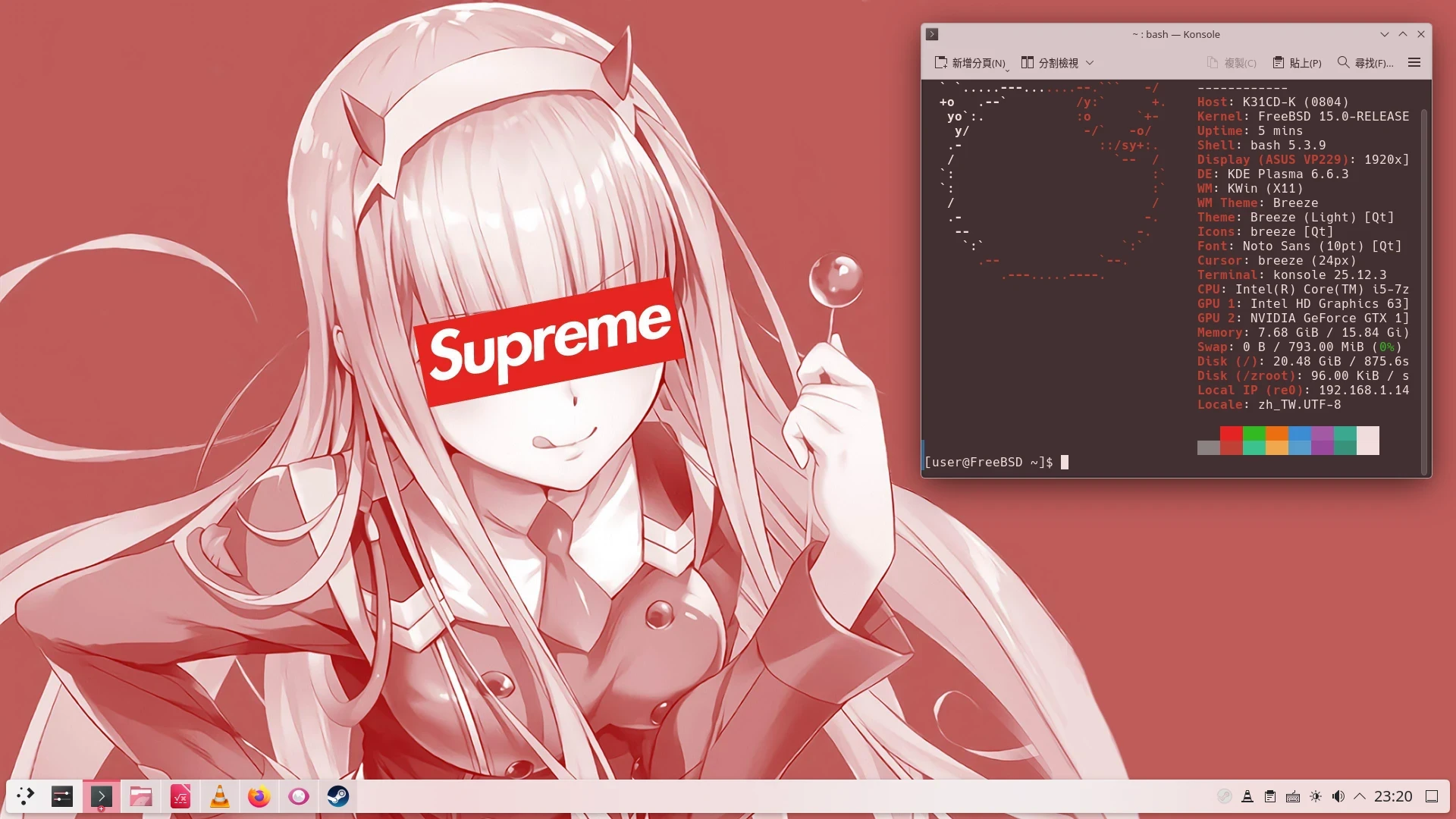
Today in 2026, jumping from the Linux ecosystem to BSD is equivalent to turning time back to the barbaric era 20 years ago. I can tolerate software not working, but if even hardware drivers are missing, that will not do.
Compared with the Linux ecosystem, BSD’s advantages are not very obvious. This makes me think: it turns out probonopd (inventor of AppImage) and Bryan Lundukee (former openSUSE employee) are both BSD-style Linux users, and Lunduke seems to use OpenMandriva. Then one can understand their criticisms of the insane actions of the mainstream Linux world. FreeBSD development progress is more conservative than Linux. In the eyes of modern Linux users, users who still insist on Unix philosophy are easily regarded as lunatics, such as those who oppose Systemd and use traditional init, criticize Wayland breaks everything and insist on using X Server, and so on. Their viewpoint comes from the idea that these programs should not only serve Linux, but should also consider portability to other Unix-like systems. Although, well, the market share of users of these systems is close to 0%, especially desktop users. Even if software can barely support BSD, hardware driver support for BSD can be said to be extremely difficult. For example, drm-kmod has to draw on resources developed by Linux; “linuxism” is unavoidable.
So, since the current problem lies in some “standards” strongly pushed by large companies, such as Systemd, Wayland, Flatpak, PipeWire, and so on, then all we need is to use Linux distributions that do not deliberately follow these things. There are still some Linux distributions that follow Unix philosophy. Linux is a highly modular system, and components other than the kernel can be swapped out.
For the most basic init, if you do not use Systemd, there are actually many choices: No systemd - Resources against systemd and alternatives. They allow you not to be led around by mainstream standards.
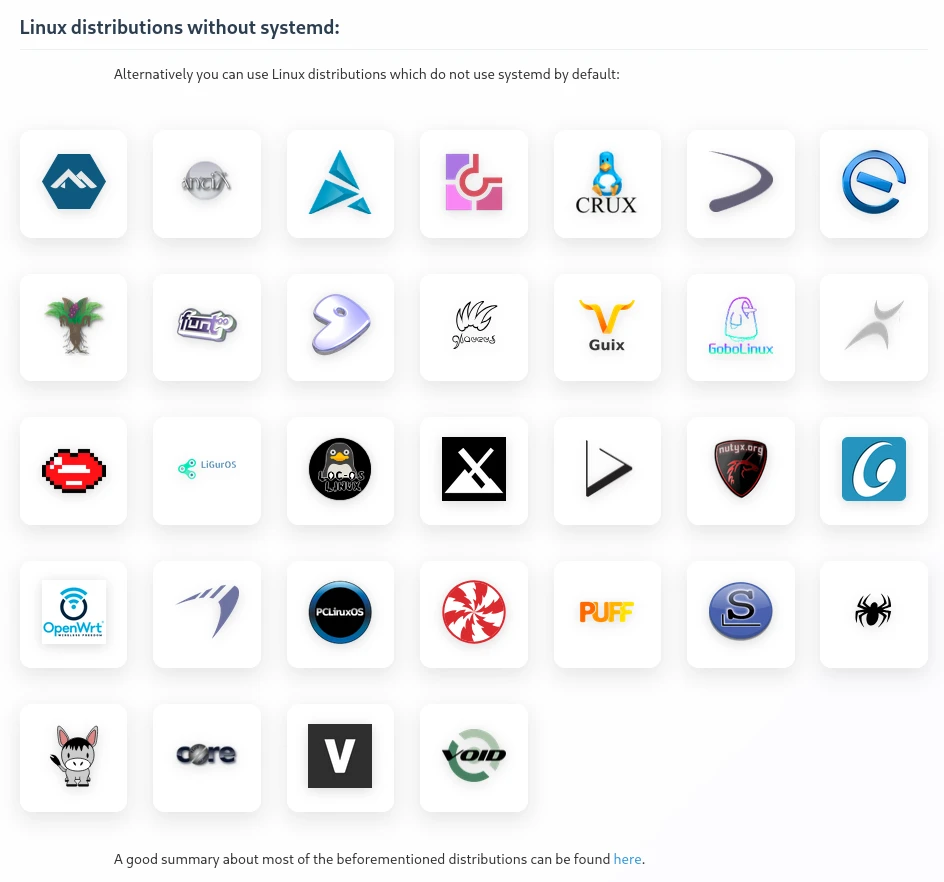
However, as long as I need to use Google Chrome to handle Google Docs for even one day, it is impossible to go completely against the mainstream (meaning against the rules formulated by Fedora & Ubuntu). I do not live in a basement typing at a computer all day; I still have to communicate with “normal people.”
Personally, I think not all standards promoted by large companies are bad. For example, Flatpak is indeed convenient, but users must have the freedom of choice. One should recognize the awareness that there is freedom of choice, rather than spreading both hands and saying, I cannot do anything, this is the trend.
Installing these Linux distributions can obtain a bit of returning-to-simplicity effect, without falling into the too-narrow predicament of the BSD ecosystem.
If we choose to go against Linux mainstream trends, we must bear this fate.
“Resolve” is not a spirit of sacrifice! “Resolve” is carving out a path to move forward through the dark wasteland!
After Actually Trying Unix Philosophy: I Surrender #
Fine, I have almost surrendered. I have always used Debian and Arch Linux, with the KDE Plasma desktop. Originally, I wanted to completely abandon Systemd and Wayland, and use distributions with OpenRC and X11 (XLibre), such as Devuan and Artix Linux, because I might be more familiar with these distributions’ structures and they can get closer to Unix philosophy. But I found it was truly painful.
Especially because the devices I want to deploy on are not only desktop computers and ordinary laptops, but must also be usable on convertible tablets such as the Surface Go. I want Linux to work across devices!
I installed Artix Linux on a Surface Go 2. In actual testing, OpenRC booted about 10 seconds faster than Systemd (about 20 seconds from a cold boot on eMMC to entering the KDE X11 desktop). Also, perhaps because fewer services were started, OpenRC’s RAM usage at idle was 200MB less than Systemd, only 1.6GB. For this device with only 4GB, every extra bit is precious.
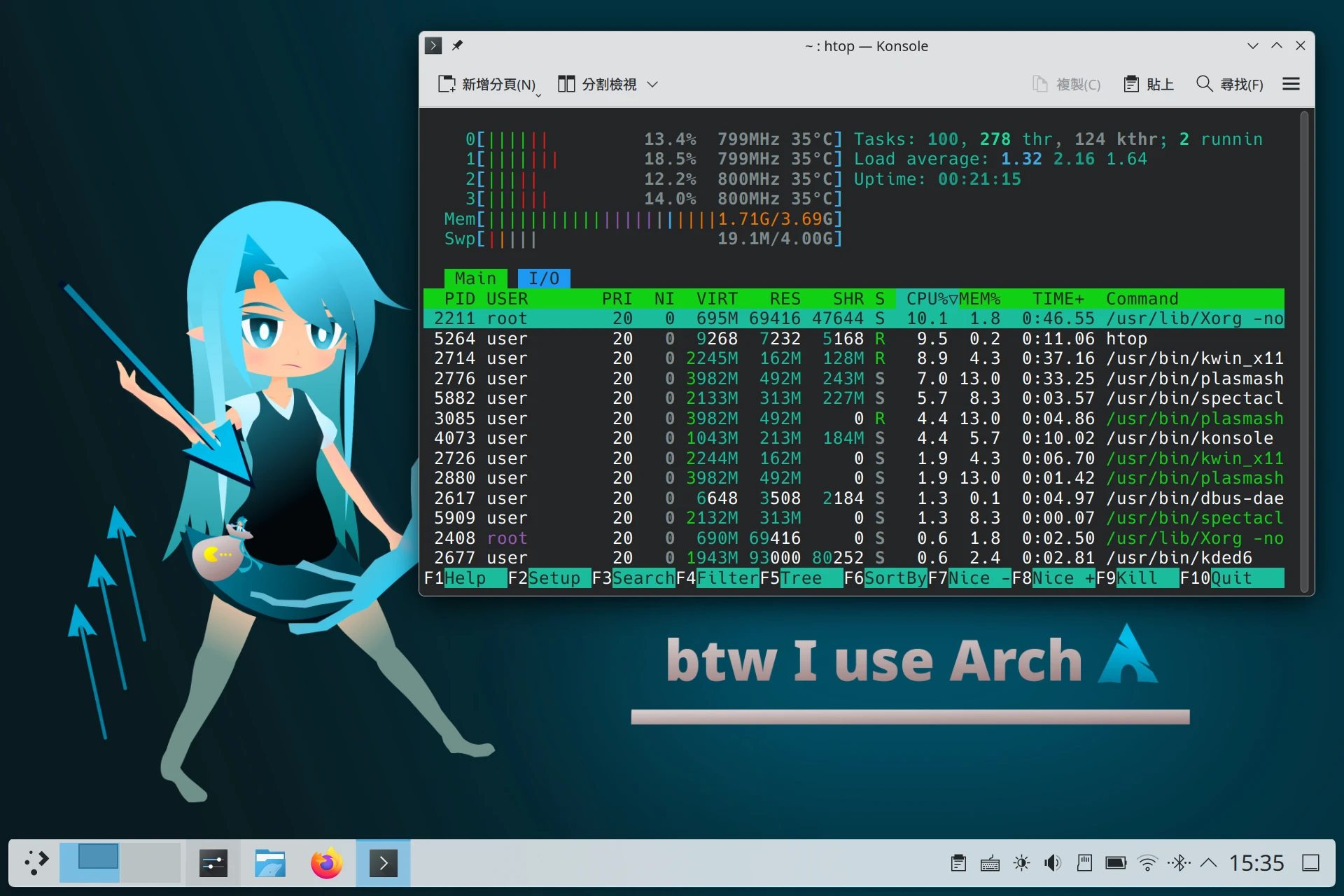
But the rest of the operation was awful. This very much needs Systemd to automatically manage various sensor services, as well as Wayland’s fractional scaling support. Without them, doing things is very difficult. I am a graphical-interface person, not a CLI person, so the desktop experience must be good. Clearly, non-Systemd distributions cannot do this, or lack maintenance.
What the hell is this place? Sure enough, modern things like Systemd are still needed!
Taking Artix Linux as an example, without Systemd, various services need to be started manually. KDE also has all kinds of strange crashes. Mainstream desktops are migrating toward Wayland, and X11 is ready to be locked in a museum. X11 is very unable to adapt to switching among multiple input devices, such as touch and mouse input events, and is only suitable for keyboard and mouse operation.
Therefore, I can basically say that distributions using OpenRC + X11 are only suitable for traditional desktop computer operating environments, and you must be a super keyboard warrior (able to type in Vim without looking at the keyboard at all) to find them easy to use. Deploying on new-era mobile devices is still too difficult. Yes, we are a “degenerate” generation, each generation worse than the last, but we will not choose conservatism.
In the past week, I seem to have been too strongly fooled by information from far-right conspiracy theorists in the Linux community (such as Lunduke), following them in believing that the optional age verification field soon to be added in Systemd 261 is a conspiracy to cooperate with government mass surveillance, and thinking Wayland is a garbage thing that will never be finished, even believing that following some old men of Unix philosophy and staying conservative is best. Under overreaction, I backed up data, jumped ship at light speed, and reinstalled a system without Systemd.
Now I have discovered that I have gradually become used to the existence of these modern technologies. Systemd is very complicated and violates Unix philosophy… so what? As long as it is still open source software and can be supervised, then it is fine. It is not like Android system GApps, that thing that monitors you 24 hours a day.
Wayland is probably at a 90% software-complete state in current mainstream desktops. Although it cannot reach 100% stability, almost all the functions I commonly use are fine. When I run into functions that require X11, I will talk about it then.
After trying for a few days, I switched the system back to Debian and continued using Systemd and the KDE Plasma Wayland desktop.
In the future, I should consider finding an image-based system as stable as Debian to migrate to. Although things developed by large companies are not necessarily what you need at the moment, do not go backward again and insist on such pure Unix philosophy. Sometimes, necessary progress is necessary.
People who can’t throw something important away can never hope to change anything.