Free Software Extremism isn’t Far Enough. ← This title is so good I just copied it directly.
Why should we use free software led by Linux? Well, many people have already offered their brilliant opinions on this topic.
However, if you pursue free and open source everything…
You will be unable to move an inch.
This is a trap that some users who come into contact with Android & Linux and then follow the open source faith easily fall into.
The reason it is called extremism is that you stubbornly fight all the way to the end, refusing to compromise. You become an “open source chihuahua,” or an “open source obsessive,” going everywhere to “educate” Windows and macOS users that they should repent and use Linux.
Thus, you force yourself into an ideological dead end.
Note: In this article, when I use free software, most of the time it also includes the definition of open source software.
Swallowing the Red Pill #
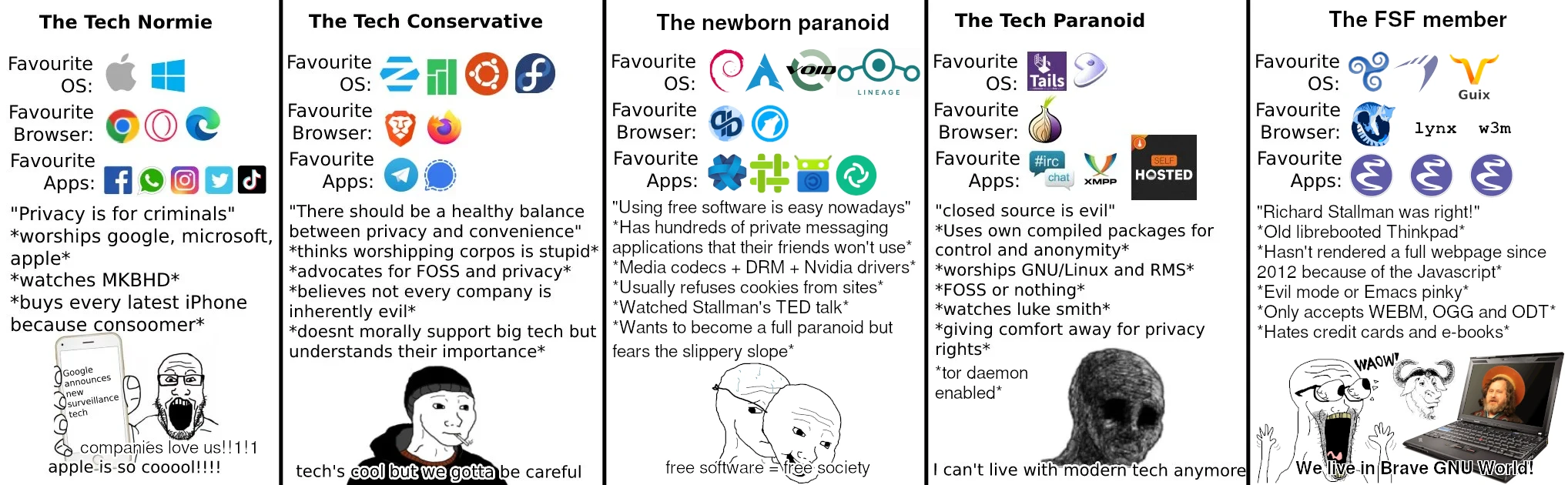
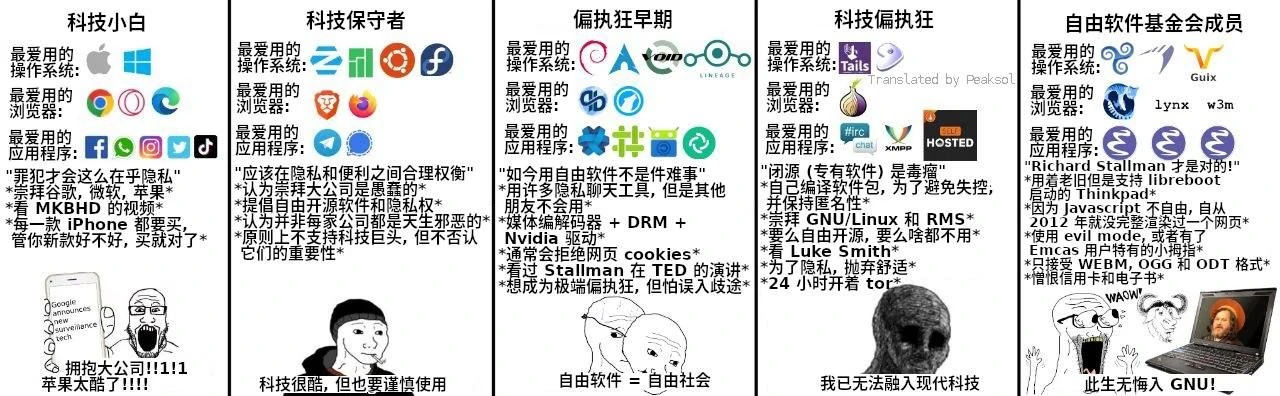
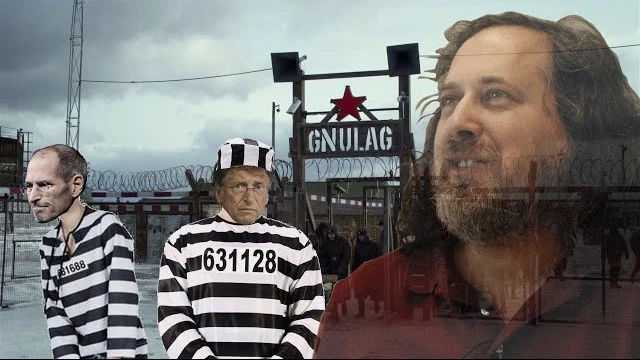
We can understand how far the most fanatical free software lovers can go by looking at this tech newbie vs. tech master image. I once had the experience of sliding toward the right side, but because of various factors, I ultimately did not reach the most extreme state. I realized that humans do have limits after all, so my current state is somewhere between 2 and 3.
In another crazy universe, Jobs and Bill Gates, who made proprietary software, would both have to go to prison. From: Luke Smith - Free Software Extremism isn’t Far Enough.
If you enter the world of free software through some of the “manifestos” from the Free Software Foundation, rather than merely learning about open source culture through Github, it is very easy to be brainwashed by this idea and become a believer in free software ideology. Cannot understand it? Here are some Chinese translations, and the tone is very intense: GNU專案的理念思想
The most important part is the four freedoms:
Freedom 0: The freedom to run the program for any purpose.
Freedom 1: The freedom to study how the program works and modify the program to suit your own needs. Access to the source code is a precondition for realizing this freedom.
Freedom 2: The freedom to redistribute the program in order to help your neighbor.
Freedom 3: The freedom to improve the program and contribute those improvements back to the community, so the whole community can benefit. Access to the source code is a precondition for realizing this freedom.
This feels like reading The Communist Manifesto. It has strong agitational power, and with its emphasis on the spirit of sharing, it easily makes people think this is communism. But free software is not communism; I discussed this in a previous article.
Believers in free software ideology think that insisting on free software is an act consistent with moral principles. Therefore, they gradually begin detoxing the things around them, to the point that from top to bottom, they pursue absolute “freedom.” They swallow the red pill and gradually understand the truth of the world.
In terms of playing with computers, you first start by replacing the operating system your computer uses. You choose a Linux distribution you like, use Ubuntu under the bandwagon effect, or use Arch Linux to look cool. Then, as you study 開源軟體的授權差異 - OCF in depth, you begin insisting on only using open source solutions that respect user freedom, such as switching from Chrome to Firefox.
You know you cannot rely on any proprietary software. Games must be open source. File formats must use patent-free .odt, .ogg, .webm, .avif, and .xcf. Besides email, you also provide a GPG Key for trusted people to sign. The software license terms you use should all be GPL. MIT, BSD, Apache, WTFPL, and the like can step aside; they do not “protect freedom” enough.
You want to escape the walled gardens of big-company cloud services, so you start messing with self-hosted stuff, beginning with Nextcloud to recreate the entire Google family bucket.
Then your hands and feet gradually reach down into the low level of hardware. You learn that the Linux kernel contains too many non-free firmware blobs, so you have to switch to the linux-libre kernel and expel them all. This affects your future hardware purchasing preferences, leading you to choose network cards, graphics cards, printers, and so on that do not require special drivers to use.
At this point, you begin insisting on calling Linux “GNU/Linux,” emphasizing that the spirit of Free Software is more important than Open Source. You already have moral mysophobia. Mainstream distributions that claim to respect free software but still include proprietary software, including Debian and Fedora, can no longer satisfy you. You decide to use FSF-approved ethical GNU/Linux distributions, refusing to use any operating system that contains proprietary software and proprietary firmware.
At the very end, you replace the motherboard’s boot firmware with Coreboot. After that, any computer you buy must be an old Thinkpad model that supports Coreboot.
Systemd is too evil. It is RedHat’s conspiracy to unify the Linux world. You must use a Linux distribution that insists on “init freedom.” If GNU/Linux cannot satisfy you, you might use FreeBSD, or find projects like TempleOS and start developing your own operating system.
If you extend the concept of free software to phones, you gradually pursue Degoogle phones and only use open source software from F-Droid. You gain a completely free LineageOS system through flashing and Root. You may even begin studying real mobile Linux systems such as Ubuntu touch and postmarketOS, and spend money buying phones from niche manufacturers to flash Linux onto them.
At this point, the attitude toward free software turns into a religious faith. Toward opposing views, you simply oppose them obsessively to the end and refuse to compromise. You become an open source chihuahua, going everywhere to “educate” others that they should use free software.
Even when you encounter obstacles, you brainwash yourself by saying that insisting on the free software line is itself a kind of sacred ascetic practice. If, out of pragmatic considerations, I no longer reject the things ordinary people use, then I lose a kind of existential value. I would fall into the things pursued by vulgar ordinary people! No, I don’t want that!
Observing Famous Figures #
The open source community is a huge international community. It is hard for us to list every example, so let us look at two giants.
As the initiator of the GNU movement and the FSF foundation, Richard Stallman can be said to demonstrate this by personal example.
We can glimpse this from the practices Richard Stallman mentions on his website, How I do my Computing. From top to bottom, from software to hardware to web pages, everything must be free software.
He uses a ThinkPad with free boot firmware, GNU Boot. For his distribution he chooses the completely free Trisquel GNU/Linux (he emphasizes that he has no particular preference among distributions). When browsing the web, he uses LibreJS to filter out all non-open-source JavaScript. He does not use smartphones full of proprietary software.
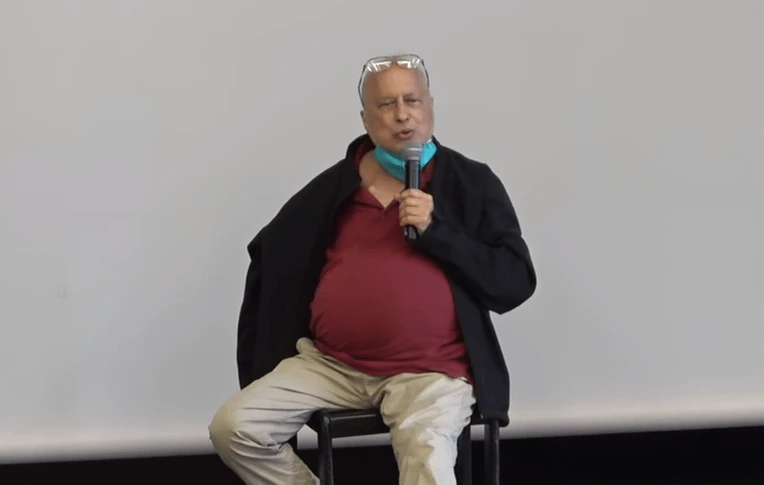
Sometimes, Richard Stallman refuses to use a projector at a lecture venue because it runs proprietary firmware.
Ah, you say he is one of the elders of the GNU Project, so why does he not use the GNU/Hurd system? Wuwu, please do not… say any more.
Compared with Richard Stallman, Linus Torvalds, the founder of the Linux kernel, counts as a pragmatist. As long as someone is willing to use Linux, that is enough for him. He does not insist so much that everything must be completely free software.
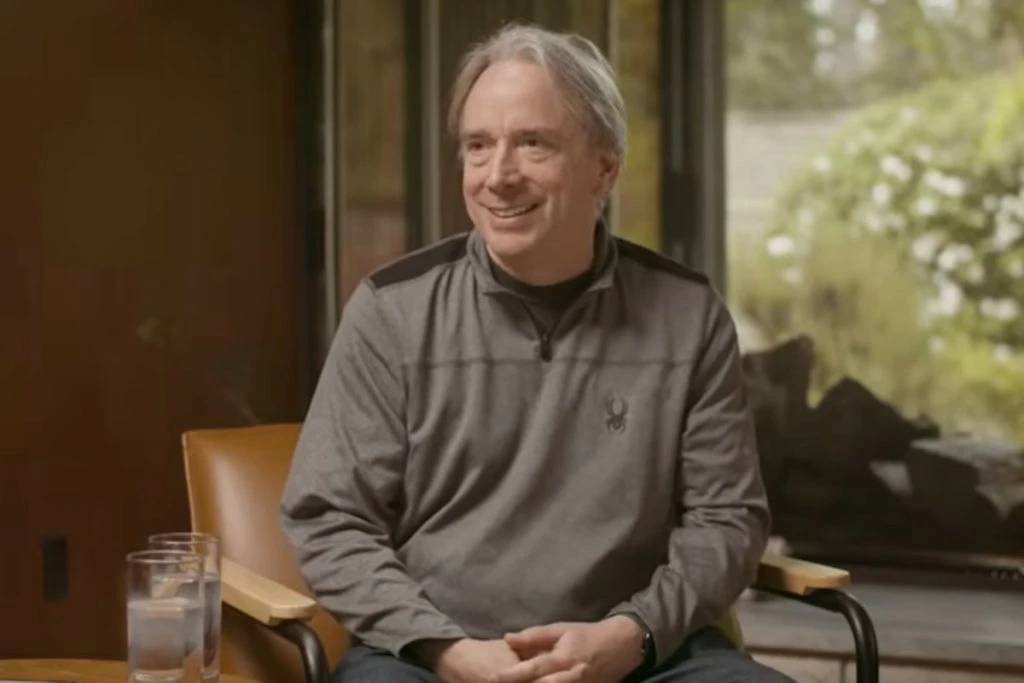
He may be too busy with work and have no time to write articles about his own usage situation, so we can only infer from fragments in news reports.
According to this Phoronix report, after 2020 his main computer configuration was AMD Threadripper with Fedora.
As for phones, naturally he chooses Android. He has used Samsung Galaxy. When filming with the other Linus in 2025, the phone in his hand seemed to be a Google Pixel.
He has criticized many Linux distribution maintainers for loving to break userspace after updates.
He said in this video that he does not like Debian because it is too hard to install. He may choose Fedora because it keeps up with the latest versions of software.
In 2022, in order to develop the Linux kernel for the ARM64 architecture, he began using a Macbook with an Apple Silicon chip, showing that he does not reject companies that specialize in making proprietary software at all, as long as they are willing to cooperate.
In 2025, Linus and the other Linus built a new computer with an Intel graphics card. In any case, he would never look favorably on Nvidia, middle finger. This shows he is an open-minded person.
In his attitude toward free software licensing, Linus Torvalds opposes updating the Linux Kernel from GPL 2.0 to GPL 3.0. The reason Richard Stallman and the FSF proposed GPL 3.0 back then was to prevent large corporations from abusing open source software and releasing software that is open source on the surface but cannot be freely modified. See the Tivoization phenomenon. Therefore, the new version of the GPL license added more restrictive terms to prevent loophole abuse and protect free software from being taken away. However, Linus Torvalds believes it is enough to preserve the principle: “I give you software. You can use it to do anything you want. If you make any improvements, you need to hand them back to me.”
He probably believes that imposing overly strict restrictions on Linux would make more companies hesitate and not dare to use Linux.
It’s a Dead End, Be Practical #
Just like the ending of the final volume of the manga Girls’ Last Tour, after the two characters pursue hope for a long time in the apocalypse and climb to the very top of the world, they discover there is nothing there.
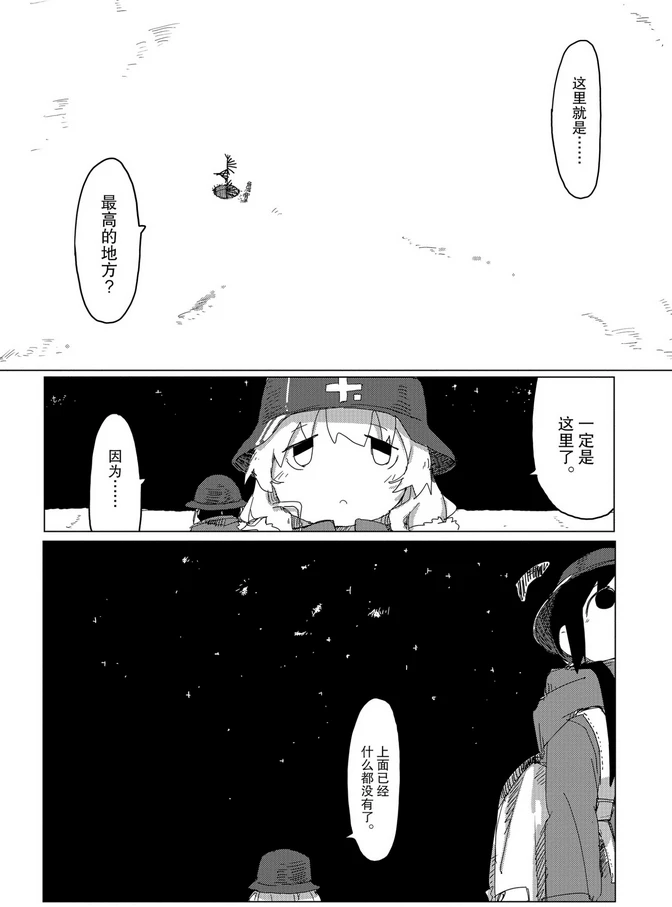
In practice, achieving completely free software is simply impossible. Even if you are a super programming master, you cannot completely abandon proprietary software.
Free software should not include restricting other people’s freedom to use computers. Use whatever you think is easy to use; there is no need to feel moral guilt. You can still love free software, and then switch to free and open source solutions when the time is right.
Our world needs pioneers like Richard Stallman, but you do not have to follow along and become an intense martyr.
When persuading others to use free software, do not merely repeat religious-style doctrine. You should provide more practical reasons.
As for myself, although I still prefer using Linux systems, I do not reject occasionally opening Windows and macOS to play around. In choosing everyday software solutions, I am very happy to research all possible solutions, but they must not obstruct me from reaching my goal.
To learn the small and neglect the great: I have not seen the wisdom in that.
On phones, fully degoogling is really too hard. For example, not installing GMS services on an Android phone puts you in a dilemma. Can we refer to Proton’s article explaining Theart model, apply that theory to analyze how to degoogle pragmatically, and avoid falling into paranoia? For example, you can start by not using Gmail as your main email. Set up risk-avoidance methods and slowly leave the Google ecosystem.
Do not make an extreme one-size-fits-all cut.
Free software and proprietary software are not necessarily in a state of total incompatibility. Recognize that other people are the world, not hell.