Learn From Proprietary Software, Then Apply Those Skills to Free Software, Just Like Switching From Microsoft Office to LibreOffice
Why is it that the computer office and image-processing software operations taught in school always promote proprietary (closed source) software?
Why must reports be written with Microsoft Office, photo editing done with Photoshop, video editing done with Premiere, modeling done with Maya, statistics run with SPSS……? Even reading PDFs absolutely requires downloading Acrobat, and extracting non-.rar files also requires WinRAR. All these many things, without exception, are proprietary software? Usually proprietary software is commercial software. Although some of it is free of charge to use, it is neither free nor open source, and the license terms often restrict the scope of use.
If You Learn Proprietary Software From Childhood, Is There Any Possibility of Awakening and Switching to Free Software? #
I remember once reading an extreme article on Xuite. In a conspiratorial tone, it accused Taiwanese schools of teaching only how to use Microsoft products, including Windows and Office, as a typical collusion among government, industry, and academia! Microsoft opened cram schools across Taiwan to train instructors, companies all use Office products, and then students are forced to learn Microsoft products so they can meet the talent needs of companies. We should be teaching Linux and free software instead!
I agree with the article’s point of view, and the same applies to software for other uses. Schools eagerly talk about using proprietary design software, such as the Adobe suite, and many professional engineering programs are also proprietary, requiring expensive licenses. They start from when students are still children. Proprietary software is learned from elementary school to university, with everyone diligently working toward certification exams, as if there were no other choices in the world. Ask them why these programs must be adopted, and they will say this is the industry standard; if they do not teach these, students will have no jobs after graduation.
But if it has always been this way, does that make it right?
To be honest, I cannot offer any solution either. The Software Liberty Association Taiwan once promoted the ezgo operating system, an Ubuntu system carrying a customized KDE desktop with built-in software corresponding to various school subjects, intending to promote free software…… It is still maintained, but it does not look very successful, and its reputation is not as strong as internationally mainstream Linux distributions. Most schools continue buying Windows licenses, or spend heavily purchasing Macs for artistic needs. To see free Linux on campus, you probably have to go to computer science department labs.
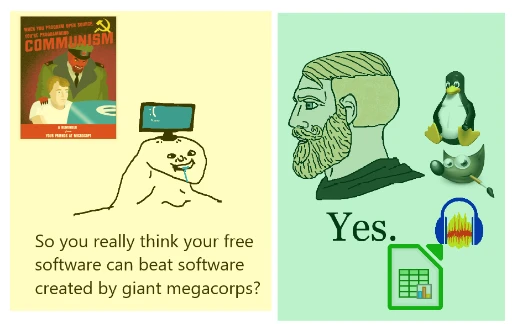
Although the promotion of free software on campus has made a tiny bit of progress, and there are successful examples of free software migration in the corporate world, such as the Free Software Service Vendor Alliance, and the Taiwanese government has also comprehensively promoted using ODF format to exchange official documents, the cruel truth is that free software still cannot beat commercial software. Whether in the mainstream market or in many people’s minds, free software is not a primary choice. Some people even think free and open source software information is too messy and harder to use. Without strong vendor involvement in maintenance, they dare not use it.
In practice, it is difficult for campuses to abandon the world of Windows and proprietary software, because this is regarded as one of the abilities needed in future workplaces, a ticket to the real world. And to integrate into this real world, one must start from the basics. Only after that is there the possibility of “change.” The Taiwanese government cannot be like China, changing everything from top to bottom to Huawei computers in order to push a supposedly domestic operating system that is basically a reskin. That is impossible, and the Chinese government’s main purpose is not promoting free software either, but consideration based on its own national strategic interests.
Therefore, change must be gradual, and the philosophy of freedom must continue to be promoted to improve public awareness. Thus, I think the computer office and image-processing software operations learned in school in the past still have positive meaning, at least for building basic computer literacy. As people’s visual horizons broaden, they realize that computer software is not merely a homework tool to be thrown away after use, but an existence that pursues higher values. Naturally, they will come to know free software and understand its value.
And now my thought is often this: how to apply proprietary software operations to free software, even if it means taking a few detours, reading a few more manuals, or writing a bit of code. Operations that were originally taken for granted in proprietary software require collective effort to achieve after switching contexts.
For example, when switching from Microsoft Office to LibreOffice, I do not reject it just because the interface is uglier. Instead, I can learn more methods of doing things, advocate the international open standard ODF, avoid hacks that only work with specific software, and refuse to rigidly follow old conventions.
Likewise, Photoshop -> GIMP/Krita; Illustrator -> Inkscape; VideoStudio/PowerDirector -> Kdenlive. Based on the basic concepts learned before, understand them comprehensively and transfer the concepts to free software. Now everything advertises AI. Even when learning the concepts of new software, I will actively absorb them. After grasping the essentials, I turn the thought around: how can I select the proper combination of tools in free software to fulfill these needs? That is right, the tools here are plural. Perhaps one open source program cannot replace the functions of one proprietary program, so combine multiple projects together. For example, ChatGPT can generate text and images, so I use Open WebUI with Stable Diffusion; CapCut has AI auto-subtitling, so I use Kdenlive with Whisper to reproduce it.
If you keep using proprietary software, are you not just waiting to be trapped, raised, and slaughtered? Your product idea is good, but using closed source as a monopolistic method is unacceptable. It should be made free. And so, researching open source software solutions for proprietary software has become one of my hobbies.
Where Do You Find the Free Software Community? It Has to Be the Internet #
Since the rise of Linux long ago, the internet has been an important channel for information exchange, and free software is the same. Perhaps the commercial world does not like talking about these hacker things, but in the cyber world there are many partners who will solve problems with you.
For shared appreciation of a curious piece: Thinking Different – Using Linux in Design • tim rodenbröker creative coding The author asks: can designers work on Linux computers? Is that not suicide?
The author criticizes Apple for once relying on a rebellious spirit to win over a group of designer users, making itself the industry standard, where you could not work without a Mac. But now Apple has lost its former rebellious character and thinks only about money! Many people still use outrageously expensive Macs and willingly let themselves be held hostage. Think Different: the author practices what he preaches by installing Ubuntu on a Macbook and switching to the world of free software. Even if peers look at him strangely, he still wants to do design on Linux.
Unfortunately, although the author introduced the benefits of switching to Linux, such as the concept of permacomputing, the greatest pity is that he did not mention more concrete examples. He actually said he wanted to use ffmpeg to process video!? I wanted to see him share experiences using software like Kdenlive and Krita. I very much agree with this sentence:
Creative Focus on the Core, not just the Surface.
After all, the operational concepts of many design programs are actually shared; it is just that the mindset needs to shift. If you understand it through programming concepts, you can guess how a function should be achieved. Unfortunately, many people are constrained by GUIs. They do not understand the underlying principles or how to transform their thinking. Just because the button placement in this program is different, they do not know how to operate the software anymore. Admittedly, we should not demand that computer users must learn low-level programming knowledge; they merely need to finish their work. But switching to Linux makes you understand more, ask more questions, and question things you previously took for granted. Is that not a kind of initiatory experience?
In addition, an elderly lady previously uploaded a tutorial video on how to operate ffmpeg on Debian, and she became an instant hit in the Linux community. It is the idea that even my grandma is stronger than you.
Now look at her video recommending that Windows users switch to Linux.
Why You Should Think About Switching To Linux. by Andrea Borman
She really is a pure Linux user: using Debian, installing a retro-style LXDE, and recording video with the minimalist program Guvcview. What kind of stereotypical Free Software Foundation supporter portrait is this XD. Also, this lady is anti-vaccine. But well, this proves that if you want to learn, age is simply not a problem! Free software is not really that hard to use.
By the way, I recommend Pixls. The forum area of this website is dedicated to users discussing multimedia creation with free software, including image processing, digital painting, video editing, music production, 3D graphics, and so on. Everything uses free software, and most users are Linux users, completely replacing Adobe products. Although GIMP and Krita each have their own forums, this website provides discussion space for other niche uses. For example, more people here discuss Linux color management issues, and some people share Darktable photo post-processing workflows.
But What If Other People at Work Do Not Accept Free Software? #
Of course, inevitably, work and school uses will encounter situations where files must be shared with others. At that point I can only… endure! I continue using those proprietary programs to turn in the assignment. Many people are afraid of trouble and dare not try free solutions, so I can only accept my fate. Although I mainly use Linux, I still prepare dedicated machines and virtual machines for situations that require proprietary software. If the proprietary software service is a web version, that is somewhat easier to bear, because I can access it with a Linux browser. But that does not mean I can just muddle along with Google Docs and Canva. I still hope to use free software solutions and continue exploring emerging technologies.
Sometimes I encounter people with some innate aptitude, whether peers, younger students, older professors, or other members of society, and I will take out some free software examples to preach a little. If they hold an open attitude, then I usually use handing over an .odt-format document as the first step of reform.
Learning to use free software solutions should not be something only the corporate world adopts to save money. Individuals, schools, and institutions should all learn it. After all, is the core purpose of the Ministry of Education’s 12-year basic education not lifelong learning? So it is very necessary to break out of the imprisoning cage.