Is free software, such as GNU/Linux, a kind of communism?
Free software (open source software) requires code to be open and allows others to freely use, modify, and redistribute it, which very easily makes people think of communism. This has been a frequently questioned issue since the free software movement developed in the 1980s. If we talk about the representative masterpiece of free software, it is the great operating-system family developed through the joint effort of developers around the world: GNU/Linux. Anyone, regardless of status, can contribute code, and the entire system kernel is open source and owned by the public. So does free software developed in this way count as a kind of communism?
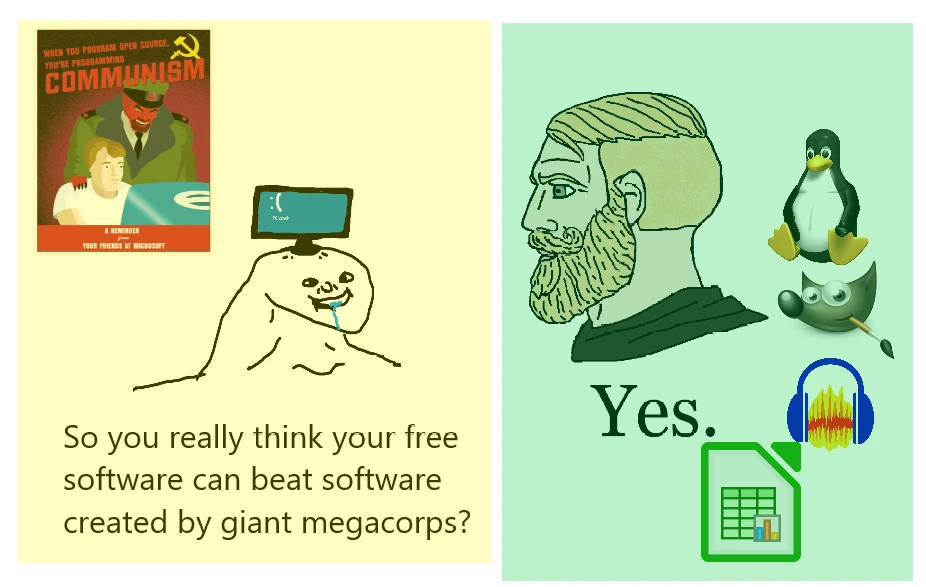
Note: the free software movement strictly distinguishes its own attitude from the open source movement, because there are slight differences in their philosophies, and each side will accuse the other of missing the point. However, this article will provisionally treat them as the same concept: that is, free software includes the ideas of open source software.
1. Deriving from theory #
If we want to ask whether the free software movement is communism, the roughest indicator is whether the means of production are publicly owned. In software development, this usually means code. In the information age, copying code has almost no cost. If development cost is not counted, the productivity of software is greatly increased.
The four essential freedoms of software proposed by RMS also have some similarities with communist ideas, but these words are precisely what most easily leads to misunderstanding.
Freedom 0: The freedom to run the program for any purpose.
Freedom 1: The freedom to study how the program works, and change it so it does your computing as you wish. Access to the source code is a precondition for this.
Freedom 2: The freedom to redistribute copies so you can help your neighbor.
Freedom 3: The freedom to improve the program, and release your improvements to the community, so that the whole community benefits. Access to the source code is a precondition for this.
The ideas of these four freedoms are also embodied in the GPL license terms written by RMS and others.
If you consider these words carefully, you will observe where free software and communism are incompatible. First, free software does not oppose private property. The GPL emphasizes the right to freely use code, but the author still enjoys part of the rights. It is not the case that once software code is released, it becomes a resource that can be used without any limits. GPL is not the same concept as CC0. On the contrary, all users should follow the license terms of free software, and use software and code under conditions that protect users’ freedom.
Furthermore, although the code is public, no one can use any means to forcibly monopolize the code, or prevent others from viewing modified content. Instead, software should be used while maintaining a free-sharing model. Although the GPL has a viral infection property, meaning that if software uses GPL-licensed components, other parts will inevitably be forced to open source as well, users can absolutely choose not to use the GPL and instead use more permissive approaches such as LGPL to avoid this problem.
So, free software and communism have a little bit of overlap, but they are not the same thing.
2. RMS’s response #
This question is still best answered by Richard Stallman (RMS), the founder of the free software movement, himself.
On whether the free software movement is communism, RMS explicitly refuted the communism claim in his 1992 article 軟體為什麼應該是自由的. Free software uses the concept of a public good. He believed Marx would not invent things to help his neighbor. Also, the free software movement does not force others to join and does not monopolize software. Applying communist concepts, RMS opposes monopolizing the means of production, and he accused the Soviet Union’s approach of being a symbol of evil.
From here, we can judge that at least RMS himself did not promote the free software movement from a communist starting point. People who radicalize RMS’s views fall into a binary opposition narrative of communism versus capitalism.
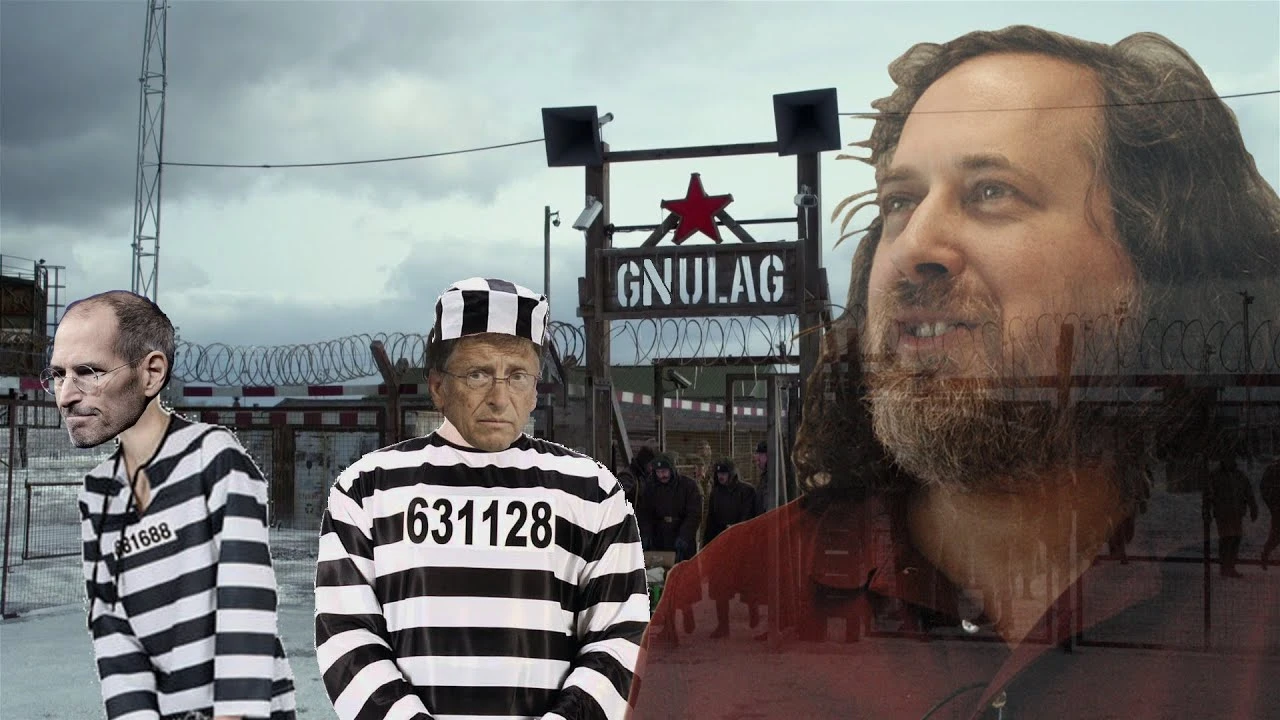
In addition, in a 2001 RMS與Louis Suarez-Potts的訪談, he did not answer directly, but said that “attacking communism is much easier than attacking the free software movement.” He believed this kind of analogy was a straw man, using the American public’s stereotypes about communism to attack something and immediately render the argument powerless. Because once you connect a concept people cannot accept with the left, anti-communist panic has a stress reaction, intuitively decides this is something bad, and rejects it.
Considering today’s attacks on the Democratic Party in American society, it is easy to reach this conclusion too: the public’s anti-communist psychology is truly too severe, to the point that any tiny socialist reform will be called a communist conspiracy. Republicans and the alt-right always repeat similar rhetoric, but never think about the fundamental problems behind it. They only know how to chant slogans and say opponents are all woke, forming a kind of populist politics.
By the way, judging from a series of political comments RMS published on his personal website in 2024, he called on people to vote for the Democratic candidate in the 2024 U.S. presidential election. It should be noted that this only represents his personal opinion, not the thoughts of everyone at the FSF.
3. Other opinions #
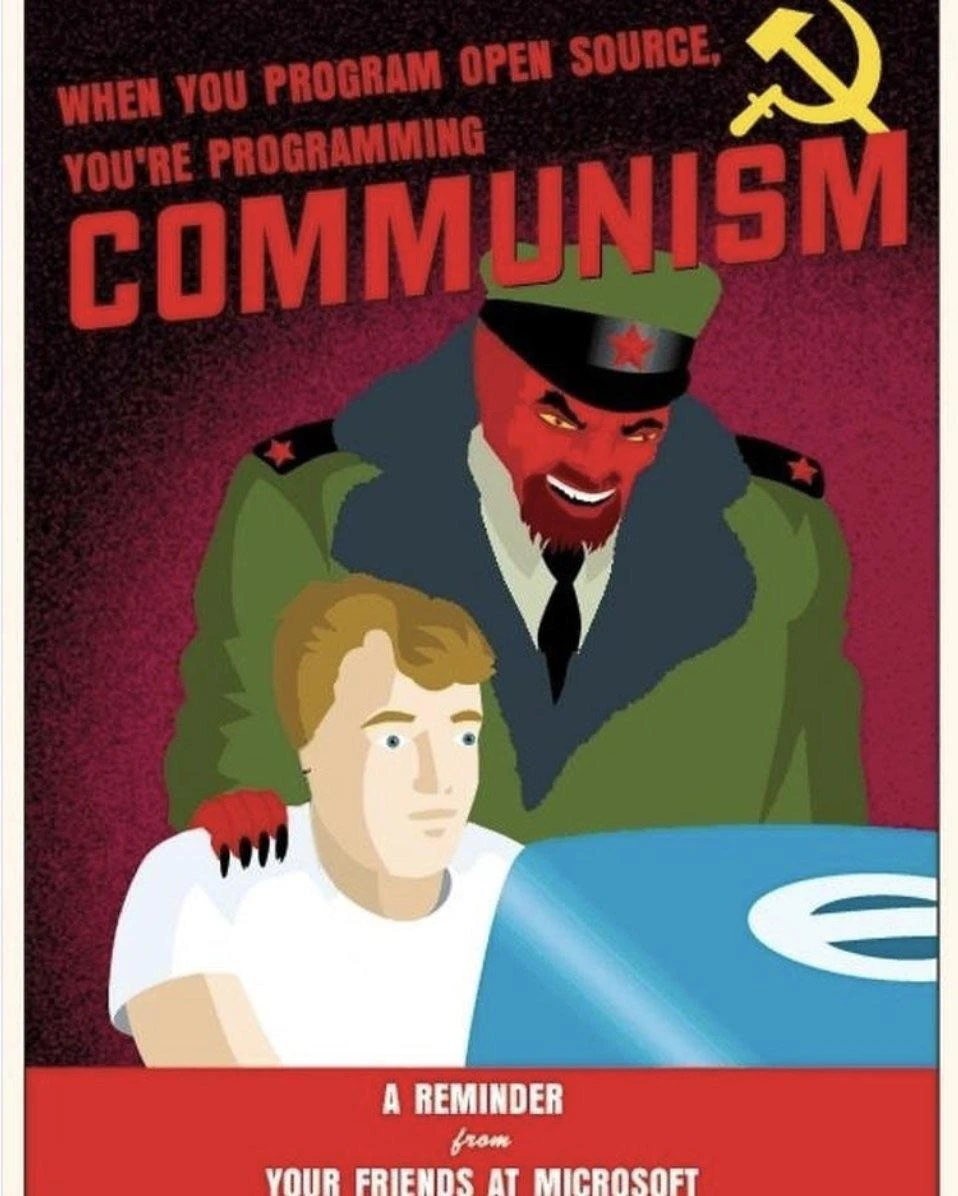
Former Microsoft CEO Steve Ballmer once said Linux is communism; see MS’ Ballmer: Linux is communism. This was probably criticism born from commercial competition, not a political-ideological discussion. After all, the Free Software Foundation once launched wave after wave of anti-Windows social movements, and then enterprise-grade Linux appeared as a powerful competitor to Windows. Now 20 years have passed, and Microsoft has started embracing Linux technology, creating WSL and cooperating with Canonical to integrate Ubuntu, no longer completely rejecting Linux systems. But some people still suspect that Microsoft only wants to use this to annex Linux for commercial purposes.
The author of the Zhihu article 共产主义=开源?开源软件的开发模式揭示了社会主义的生产组织方式 believes the free software movement is a method for promoting communism. But he criticizes the free software movement for lacking Leninist awareness of political leadership and lacking centralized leadership to raise productivity, making the movement destined to fail……According to the author’s thinking, should we organize a proletarian vanguard and smash all the products inside Apple and Microsoft stores? We might as well smash Huawei too, a rotten capitalist product.
The Reddit post The failure of the free software movement argues that the free software movement has failed. He calls the free software movement a “bourgeois utopian fantasy”, because software is developed by individual hackers, without scientific centralized management, so productivity is low. And the popularization of personal computers is also something the bourgeoisie plays with; without centralized management, it creates waste in production.
Program Think used an even more radical way to refute people’s misunderstandings about free software. In 澄清“自由软件、开源软件”相关概念及许可证的误解, he quoted Hayek’s view: communism is the end of freedom.
One extra point: free software is developed separately by many hackers, together forming a community ecosystem. This is actually more like anarchism (anarchy). The paper Software and Anarchy can explain this point. If applied to the decentralization trend stirred up by today’s Web 3, this indeed promotes the development of anarchism. This emerging concept is called “information anarchism”. This is certainly not something communists who pursue centralized state power want to see. If software is forcibly made public property, and there is only this one choice, that is certainly not the goal pursued by the free software movement, and it will in turn become an emerging force that oppresses everyone.
Therefore we can conclude that the political nature of free software is not that strong. It can only be considered a current of thought, displaying the humanistic values of mutual aid and reciprocity. And because of network development in the information age, everyone can easily participate in this activity. But it is hard for them to launch a revolution (even though the free software movement’s related organization GNU has the implication of “revolutionary slave” in Chinese), because its incitement is too low.
In essence, it is still a system played within capitalist society, improving the existing system rather than pursuing thorough social transformation.
In summary, the free software movement is not communism.
“Software should be free, and the source code must be open source to allow free use. It belongs to no one.” When ordinary passing masses who do not know much about political science hear this kind of statement, they very easily hear the spirit of “sharing” and immediately slide down the slope into communism. In reality, it is nowhere near that simple. In its programmatic documents, it does not sound at all like Capital. From
beginning to end, what the FSF and GNU want to inherit is only the free-sharing software spirit of the hackers of the 1980s. GNU/Linux could be created because of a group of programmers passionate about technology, and the future they hoped to change.
4.Are communist countries enemies, and therefore free software should not be promoted? #
This discusses the harms brought by free software from a very realistic angle. Even if free software is not communism, the code will be stolen by communist or authoritarian countries and turned into weapons that endanger Western society.
We know that free software will certainly harm the interests of some companies. It makes software no longer a means of binding users, and therefore the income of companies and even programmers will decrease. Companies pursuing maximum profit cannot easily choose the free software path. Successful cases like Red Hat are truly too difficult.
On a larger level, people who side with the United States ideologically will believe that open sourcing programming technology is secretly helping hostile countries. Taking language models as an example, although they are open source, it is very easy for people to steal the community’s achievements, which is why opportunistic DeepSeek appeared. Perhaps open source new technology can promote AI democratization, making language models no longer just a rich people’s game, but some people, based on the ideology of international competition, hostilely believe this behavior is providing fuel to authoritarian countries. Therefore free software should not be promoted.
You cannot put it that way.
It cannot be denied that the effects of free software may be stolen by authoritarian countries and treated as their own, repackaged and declared to be independently developed. And because of mechanisms of collective leadership, free software instead gets used at scale, accidentally accomplishing something good. But I also have to say that their motives are questionable. China, Russia, and North Korea use the research and development achievements of free software at scale. Their underlying motive is to make computer technology autonomous and not controlled by Western countries. So are they really using free software to promote the ideals of free software? State-controlled enterprises have successively established so-called open source culture foundations. Is there really any intent to protect freedom there? Or is it only a vanity project? Once their own technology no longer lags behind Western countries, will they close-source the technology, causing these false freedoms to vanish like smoke? This kind of behavior, whose starting motivation already carries a different motive, cannot truly echo the purpose of free software.
Some people also use cost-saving arguments to attract public agencies into adopting free software, but this method ultimately cannot beat capitalist competitive tactics. Free software can save money, but closed-source software companies can use even more discounts and returns to win you over. How do you solve that? For this reason, it is more important to promote the essence of freedom. If ideology is to change fundamentally, we cannot view free software entirely from a utilitarian angle.
Because Taiwanese people are often oppressed by the revisionist Chinese Communist Party next door (that fake communism of so-called socialism with Chinese characteristics), they hold negative stereotypes about communism. Just hearing these few words gives them goosebumps. When people discuss free software, they unconsciously think of communism, and of the massacres caused by communism’s erroneous executors throughout history, producing revulsion. Then, because of inertia from using closed-source software, they are unwilling to accept the transformation brought by free software. This is a viewpoint worth improving. At minimum, they first need to detach themselves from political consciousness and understand that pursuing software freedom does not mean falling for communism.
So one must know this: although communism and free software have areas of overlap, they are ultimately different ideas. Trying to connect the two is an act of muddying the focus. Supporting one does not automatically acknowledge the existence of the other. Moreover, judging free software by the fact that its achievements are stolen by communist countries is consequentialist judgment, and cannot negate the motivation of the free software movement itself.
Free software itself aims to promote the idea of freedom; political motivation is secondary. So the next time you hear someone say the free software movement is doing communism and harming society, you only need to smile and stare at them, and say:
“Mm-hmm, everything you said is right.”