「果てまで 気の遠くなる様な旅をしよう」
To the end, let us begin that long journey.

Learning to use Linux systems and no longer returning to Windows has finally entered its second year. For the record of my first year learning Linux and earlier, see this article.
This year was a year of completely continuous Linux system use. I did not use any other system on bare metal.
This year’s journey:
Ubuntu 22.04 → openSUSE Tumbleweed → FreeBSD 13 → Arch Linux → Gentoo → Linux from Scratch → Arch Linux → Debian → Arch Linux
Every distribution has a different color and a different culture. It is just like what the OP of Kino’s Journey sings: traveling through different countries, what a beautiful world.
1. Preparing My Mind #
Linux is free if your time has no value. Studying Linux during the senior year of a humanities student, when there is the most free time, could not be better. This time, I wanted to truly make it my main desktop system and use it in every aspect of life.
Thought brings motivation; this is self-evident. During this period, I was mostly building theory. Contact with the implementation side of systems would only begin in the next stage, “wandering around.”
In March 2022, after leaving Ubuntu, I chose to install openSUSE Tumbleweed, a rolling-release distribution with automated testing to ensure update stability, and came into deeper contact with the ideological system of free software.
For one month in May, every day I read articles from websites such as the Free Software Foundation, “Information Human Rights Nobles,” and the Software Freedom Conservancy, studied the GNU GPL license, and argued for the reasons to use free software. Richard Matthew Stallman’s Free Software, Free Society advises you to read more.
In June, this blog was established, and I began writing articles discussing free software, as well as usage tutorials for various Linux software.
After watching the historical documentary Revolution OS, this article came into being: My thoughts on the Free Software At School
Studying free software philosophy is an immersive experience almost like religion, and it gave birth to a kind of wild-take article like this: Why Give Up Minecraft. An even worse negative consequence: I once became a “free software police,” attacking those bastards who used proprietary software everywhere. I once argued with people about why translation projects should use Crowdin instead of Weblate, and in the end I was blasted for missing the point. After all, those translators really had professional work in the real world, while I did not; I was only running my mouth. Several similar conflicts broke out within a few months, which has made me much more restrained now. I learned love and tolerance, and I argue pure ideology with people much less often.
At the same time, to satisfy my then-still-unextinguished desire to play games, I went to Arch Wiki and Libregame Wiki to investigate what free and open source games were available. The final results were: Switch to Libre Games, as well as Join Minetest
While researching open source games, I gained a deeper understanding of what Creative Commons is, and how Creative Commons fills the gap for art assets that GPL cannot handle: 動漫作品可以「開源」嗎?談創用CC的實例, 開源的法國女巫漫畫:小辣椒與蘿蔔頭- 看板C_Chat - 批踢踢實業坊
The theory from this period provided a relatively clear system, letting me know that the world of free software is absolutely not so simple or monotonous.
The pursuit of free software philosophy extended into topics such as self-hosted servers, digital privacy, de-Googling, decentralized social media, anti-DRM, the true Linux phone PinePhone, and completely free and open source hardware, such as motherboards that support Libreboot. These topics are still what I care about now. Especially for the “phone,” the most important tool used every day, I believe Linux and free software philosophy must also take root and grow there.
Even if some later beliefs became shaken, I still have not forgotten the theoretical foundation laid here.
2. The Years of Wandering Among Distributions #
This stormy society… “wandering around” here is equivalent to “Distro-hopping.”
* I have two computers, one desktop and one laptop. The latter is mainly brought out for classes. Because the desktop often has to handle important computation, its Distro-hopping frequency is far lower than the laptop’s. Unless otherwise specified below, I am referring to the desktop.
In July, I came into contact with FreeBSD, which is also free software but has slightly different ideas. The BSD license allows commercial closed-source use and does not force source code to be open sourced and contributed back.
I know FreeBSD is not Linux, but I still installed it on the laptop to play with.
While using FreeBSD, I remotely taught children participating in an online tutoring program, and it never crashed.
Actually, I was lazy and installed it using GhostBSD: 在微星筆電安裝GhostBSD (FreeBSD)教學& 使用感想. Camera drivers and everything were automatically installed. The XFCE4 desktop environment with a browser and Fcitx5 had no problem handling remote teaching, and I also incidentally researched installing Steam on FreeBSD to play games, something even foreigners do not know much about.
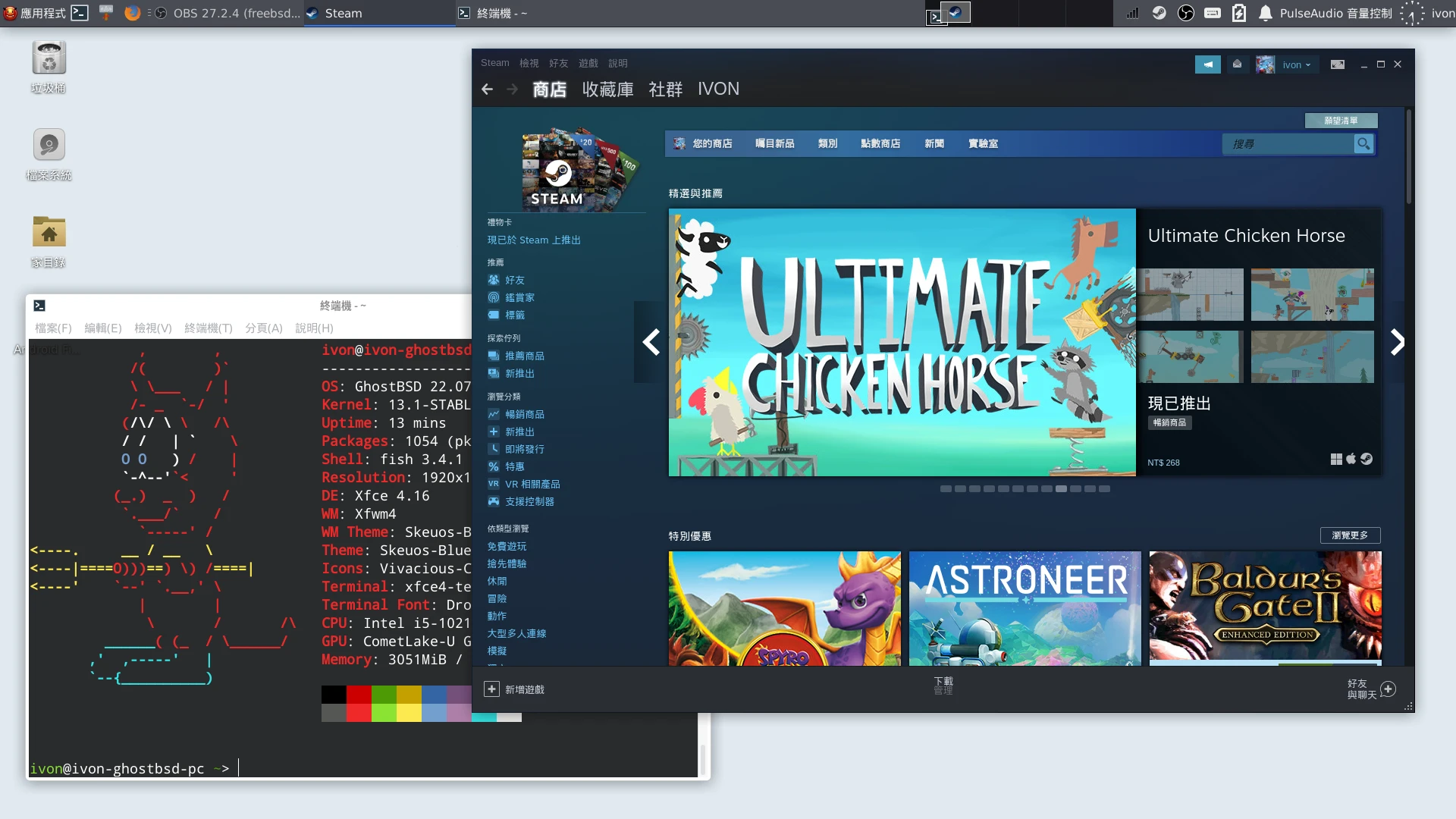
To be honest, if it is only remote teaching, even ChromeOS can do it.
FreeBSD peacefully survived one month of summer vacation, and after that I replaced it. Even now, I still think FreeBSD’s philosophy is a notch below Linux. Even though BSD systems have a lower degree of fragmentation and do not have the enormous differences among Linux distributions, their commitment to freedom is not thorough enough, and they become a milk cow that lets anyone take whatever they want. I think it is still better to be a freely gliding penguin. However, to sponsor free software, I still bought a NT$1000 T-shirt from the official U.S. store to support FreeBSD developers, then stuck the gifted sticker on my laptop lid.
At the end of July, I finally entered the Arch Linux era, and both computers in my hands were switched to Arch Linux. I experienced the pleasure of having all system packages be the newest and having to configure everything myself.
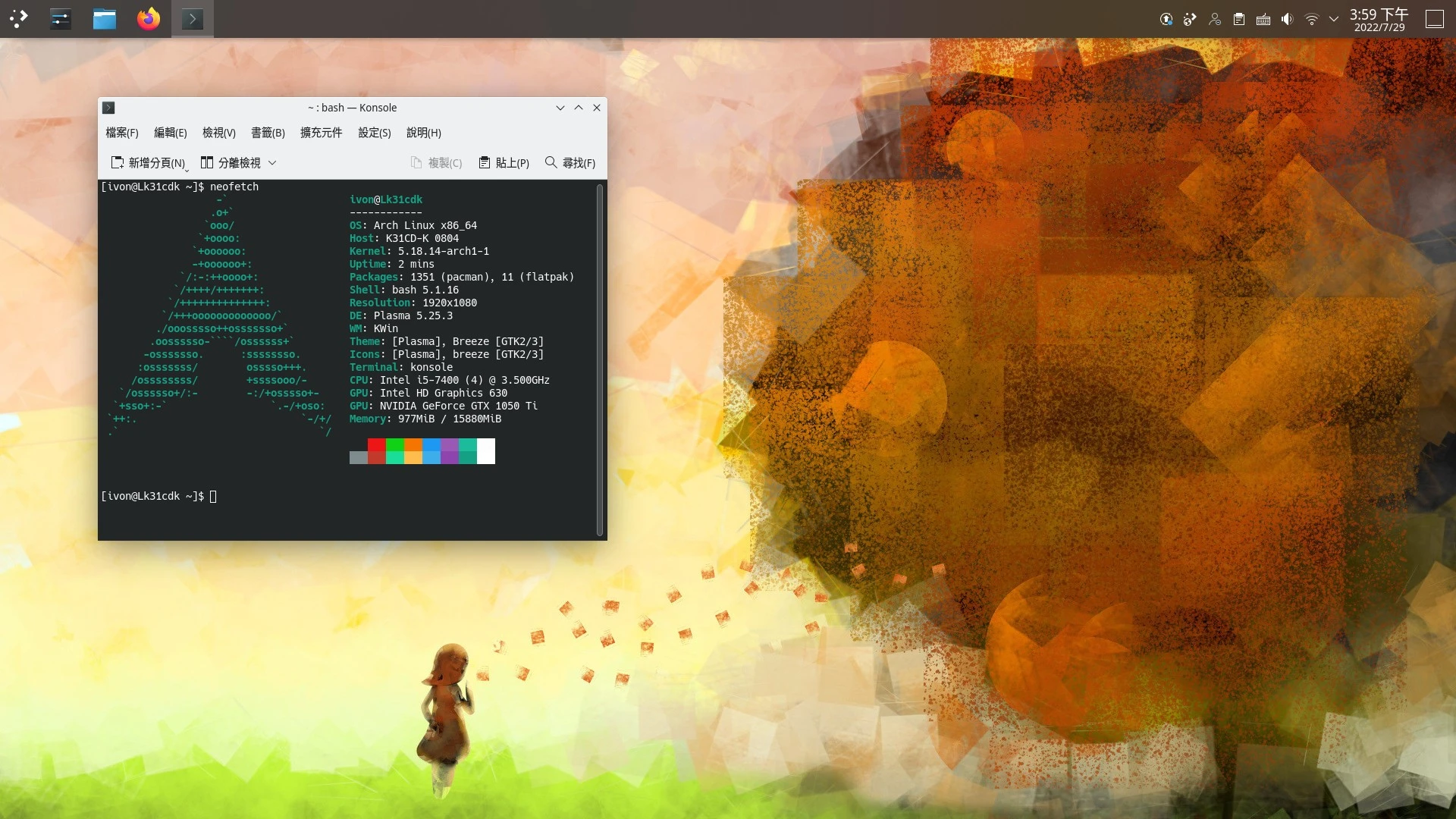
However, after playing with Gentoo in a virtual machine and being attracted by it, at the end of August I switched both computers to Gentoo: 心得 系統遷移至Gentoo紀錄- 看板Linux - 批踢踢實業坊
Using Gentoo, I experienced the pleasure that even though there is a package manager, anything you install has to be compiled from scratch, and I learned what the Systemd vs. traditional Unix init system war is.
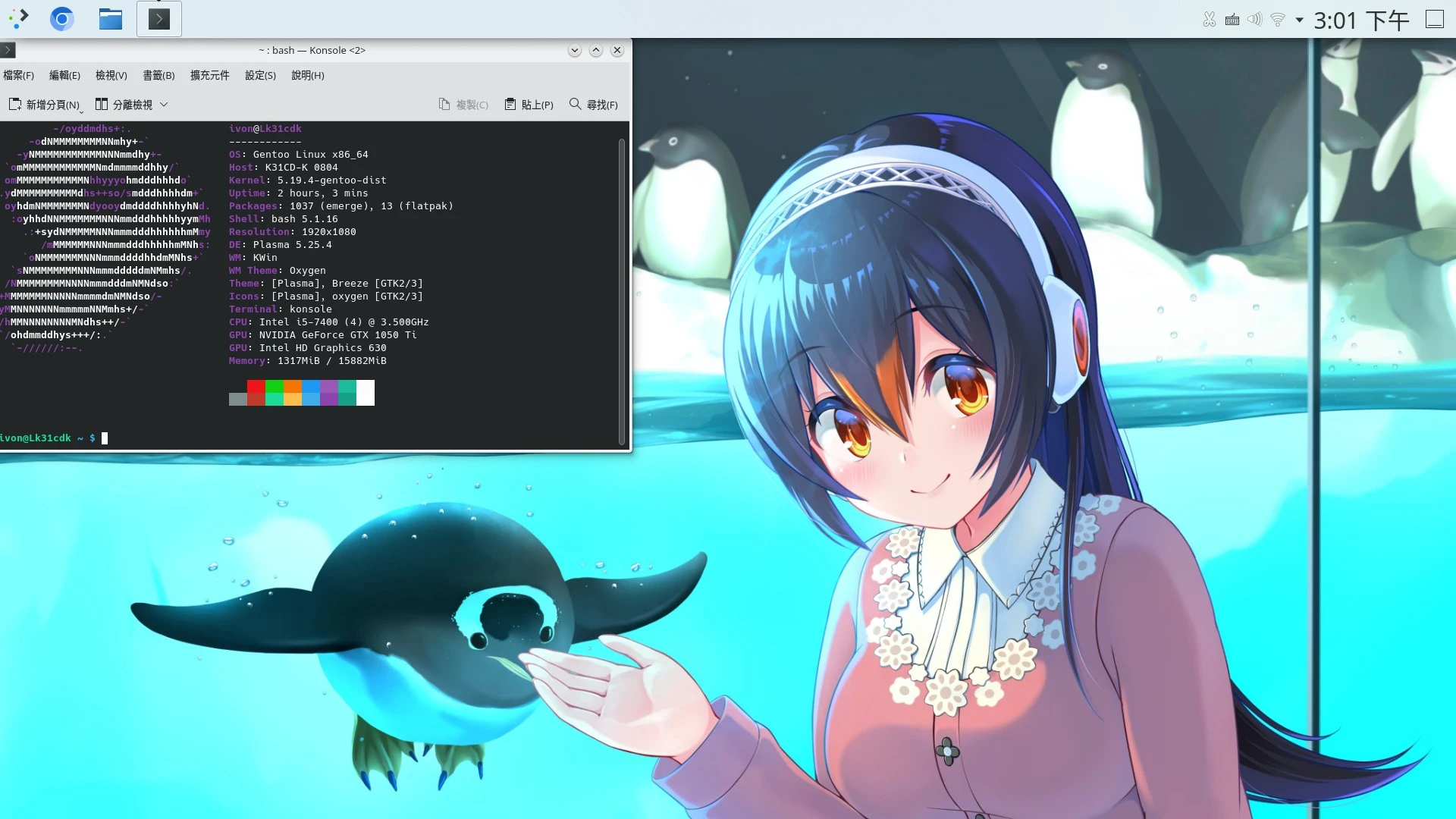
In August, I joined the Software Liberty Association Taiwan.
In September, graduate school began. Based on observation, everyone in English department classes brings their own device. In terms of device ratio, regardless of gender, half use Macbook, half use Windows, and only I use Linux. Since Linux hardware does not have much recognizable appearance, I stuck large Tux and Linux distribution stickers on the back of my laptop, and wore clothes with Tux and the FreeBSD little devil printed on them when going out. But that is as far as I went. I would not go around telling people “I use Linux btw.” For the sake of credits, if software required for class did not support Linux, I did not dare complain to the professor too much. I solved it with a virtual machine, or submitted assignments in odt instead of docx when allowed. Most of the time, nobody cares what system you use. Only once did I encounter a doctoral student who saw me typing commands and became curious. Truly awkward.
From September to November, during this period I briefly came into contact with niche systems such as Alpine Linux, GNU Guix, Plan 9, OpenIndiana (Solaris), Linux from Scratch, Void Linux, and Fedora Silverblue. Most were experienced in virtual machines, and some were written down for reference.
Only Linux from Scratch was really installed on bare metal together with Gentoo by following the manual.
Some other systems were installed on the laptop… far more than on the desktop. I can no longer remember how many distributions the laptop has had installed.
Besides that, I also had some contact with “desktop environments” such as XFCE, GNOME, KDE, and i3WM. The ones I used most deeply were KDE and GNOME, and I came to deeply understand their respective advantages and disadvantages.
Gentoo was updated once a week, and compiling new software alone took up to two hours. I still remember that at the time I would listen to Richie Jen’s “死不了” and “天涯,” and Bobby Chen’s “小雪,” while waiting for Gentoo to finish compiling.
However, because of some small mistakes, I switched back to Arch Linux in November: From Gentoo to Arch Linux
♫ If you truly love me, let me leave. ♫
Arch and Gentoo cannot be used out of the box, but they taught me many strategies for eliminating system errors: software failing to run is not necessarily a bug; it may be that some software is not installed or some service is not enabled. If hardware cannot be driven, use commands to check what kernel modules are missing, then look at Wiki and Reddit for solutions. Learning this way brought me a lot, and it is also very helpful for future program development and reading books on operating system principles.
In the end, Arch is more suitable for an obsessive-compulsive person like me, and it is not as hard to manage as Gentoo.
Time entered 2023.
In January 2023, I reinstalled openSUSE Tumbleweed on the laptop and discovered that graphical management tools like YaST are genuinely easy to use. You could say openSUSE is the distribution that integrates the KDE desktop environment best.
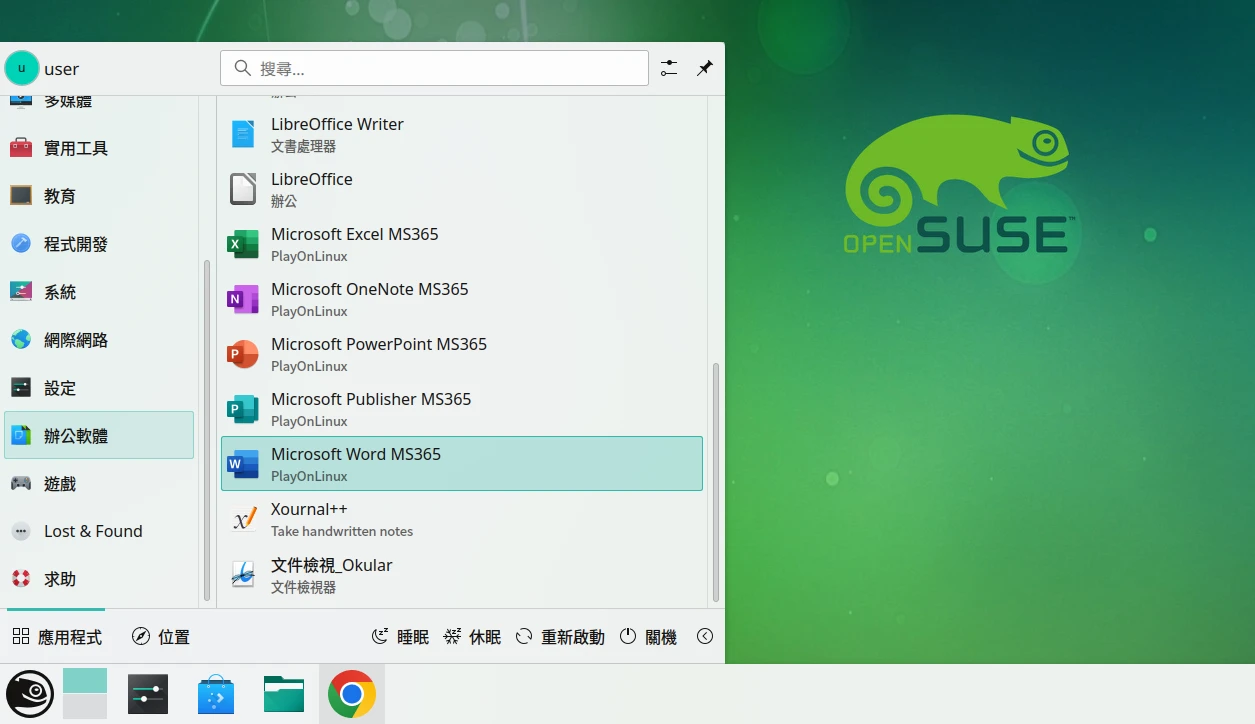
But because openSUSE is relatively niche, much software has to be compiled, or you have to steal Fedora rpm packages to install it. openSUSE’s third-party software repository “OBS” is also not as rich as Arch Linux’s AUR. So after about three months of daily use, the laptop has now switched back to Arch Linux like the desktop. Now I habitually use an openSUSE lizard as the laptop wallpaper, commemorating the good impression openSUSE gave me.
In February 2023, in a moment of madness, pursuing long-term stability, I switched the desktop’s Arch Linux to Debian Stable. I originally thought I could settle down, but later Ubuntu’s problem resurfaced: the software versions were too old, especially the KDE desktop! Even studying the official manual that promotes Debian philosophy could not stop me from switching back to Arch one week later. A system with super stable but old software is fine as a server system! I think I had already gotten used to the rolling-release model for desktop systems.
However, reading Debian’s software development philosophy taught me several important points: properly plan and maintain your system, do not create Frankenstein’s monster (randomly installing third-party packages), and do not blindly pursue new things.
By now, I have used Arch Linux continuously on the desktop for six months, already catching up to the longest period I previously used Ubuntu. If you know the principles behind it, Arch Linux can likewise be used very well.
You may ask me: with such frequent Distro-hopping, did I keep no important data on the drive? Actually, I did. Important images, videos, music, and virtual machine images, important assets expected to be preserved for more than 10 years, are placed on another drive. Some are sealed in MEGA cloud storage and mounted only when needed. And to adapt to the Linux ecosystem, I formatted those drives as BTRFS or EXT4 file systems very early on. This also represents my determination not to return to Windows.
3. Everyday Uses of Linux and What I Learned #
Using a Linux computer as the main machine is likewise for typing, browsing the web, and playing games; those points need not be mentioned, right? Class notes with Linux, presentation projection with Linux, gaming with Linux, drawing with Linux… roughly these uses.
Speaking of entertainment, Minetest is an open source block game with endless gameplay. For proprietary games, Steam can be used. For mobile games, there are various options such as Waydroid, Android x86 virtual machines, and ReDroid. Still… I increasingly feel that researching free software and writing articles to share it is more interesting than purely playing games. By now, games have become recreational tools in my life, rather than the center of life as they were during university.
In addition, daily Linux use also taught me the following three points:
The benefit of using Linux systems everywhere is that I learned remote access technologies. In the early days, I foolishly researched X11 VNC and Sunshine remote desktop technologies. Later I discovered that remote work does not need a graphical interface at all; SSH can handle it very well. Remotely editing Hugo blog files is also solved through SSHFS. (For this blog, I write markdown files locally and then push them to Github, handing them over to a cloud platform for automatic deployment. To avoid having to copy one repository to every computer, I use remote file access.)
Also, setting up development environments on Linux is very convenient. When I tried compiling an Android ROM for my own phone, I quickly set up the environment. When I saw interesting open source projects on Github, I could clone them and use Anaconda to quickly set them up and play with them. Because the Linux terminal is so close to the low level of the system, installing systems and configuring environments gave me more understanding of operating system concepts. Programming is no longer just watching a closed-source black box produce magic; it can clearly let people know what tricks are being played behind the scenes.
Finally, I learned to use Docker, set up some self-hosting services, and regularly visited Reddit’s r/selfhosted board to look at interesting self-hosted software and alternatives to commercial SaaS. Containers are really quite useful. Setting up server services does not require touching system settings at all (Arch Linux is fragile); just let Docker manage them uniformly. External network connections use ZeroTier (unfortunately, it is proprietary software), allowing me to rely on self-hosted services to a certain extent instead of closed-source commercial software. For example, SearX搜尋引擎, PhotoPrism, Invidious, Stable Diffusion WebUI, 個人AI助理, and so on.
When I sit in front of a Linux computer, I use it as an ordinary computer. When I leave the computer and close the X server to save resources, it becomes a silently working Linux server, waiting for commands at any time. It can compute even without turning on the monitor and graphics card. Using ZeroTier + SSH connections, I can manage the remote host’s various services with a laptop or phone Termux.
4. The Metaverse of Operating Systems #
“Students, for the final project we will use X software to make a mind map and Y software to run statistical analysis.”
If you ask me, when working entirely with Linux, what should you do if you really encounter software that requires Windows, or even affects the life and death of your semester grade?
The answer is QEMU/KVM virtual machine technology, which I have studied for many years. Even dual boot is no longer necessary.
If operating systems are anthropomorphized as girls, then virtual machines are the devices that let the girls enter the metaverse!
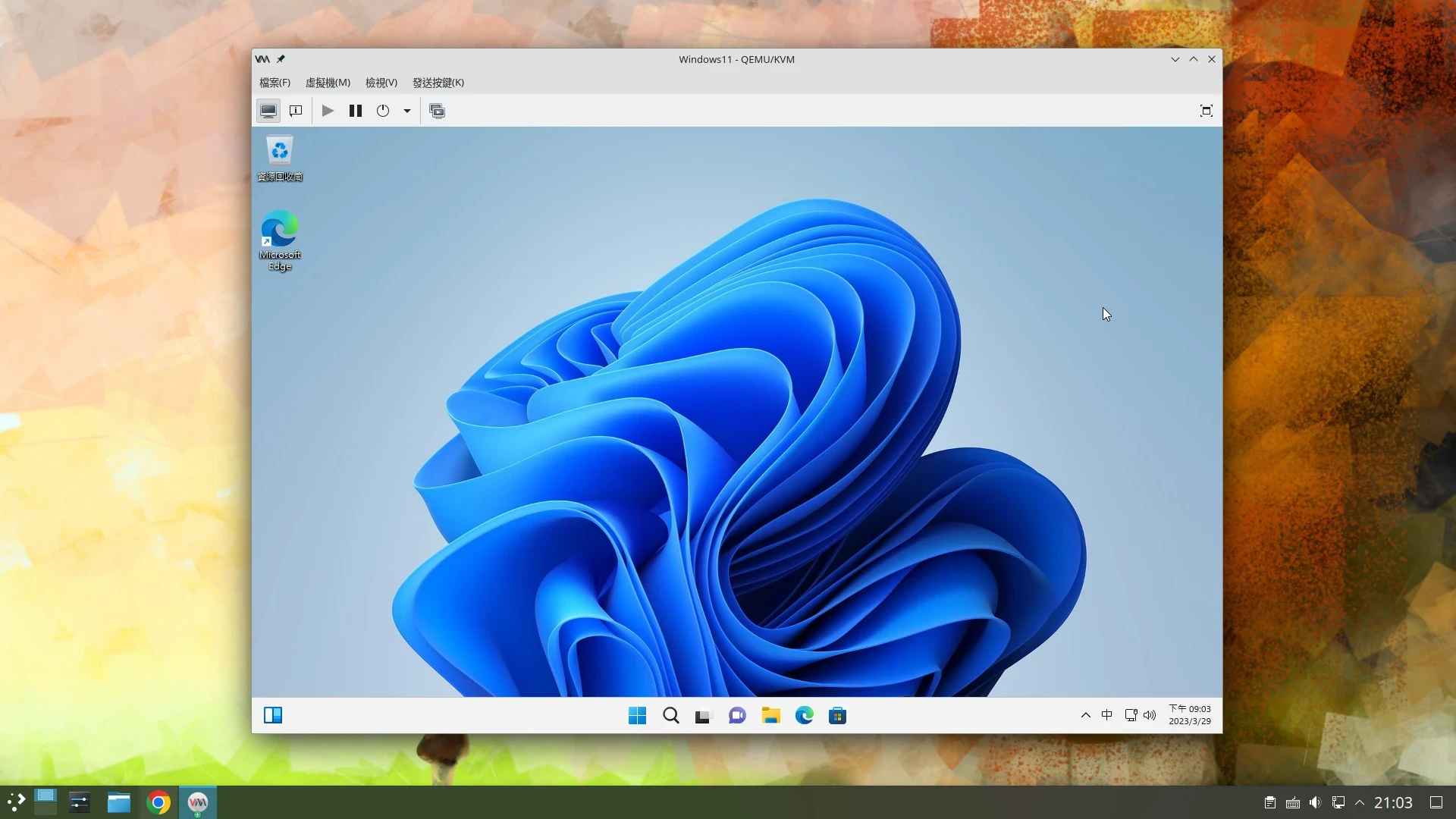
Now I am willing to call QEMU/KVM the strongest virtual machine software. Besides having the features VirtualBox and VMware should have, it also has the killer feature of GPU passthrough, and sharing hardware resources is not a problem. Therefore, a Windows VM became a life-saving treasure. But I still rarely open the Windows virtual machine, fewer than ten times a month. Basically, my workflow has been replaced by free software and web applications.
Besides installing Windows, virtual machines can also be used to test other systems, which helps me write installation tutorials for free software. For example, an Android-x86 virtual machine can be a cloud mobile phone, and a macOS VM can help me understand the development environment of the Apple fan world.
Before confirming that I really want to Distro-hop, I also run the system in a virtual machine to try it out. For example, Gentoo, FreeBSD, and Debian were all evaluated in virtual machines before being installed onto bare-metal machines.
5. A Restless Heart Settles in Arch Linux + KDE Desktop #
After a year of wandering, I returned to Arch Linux.
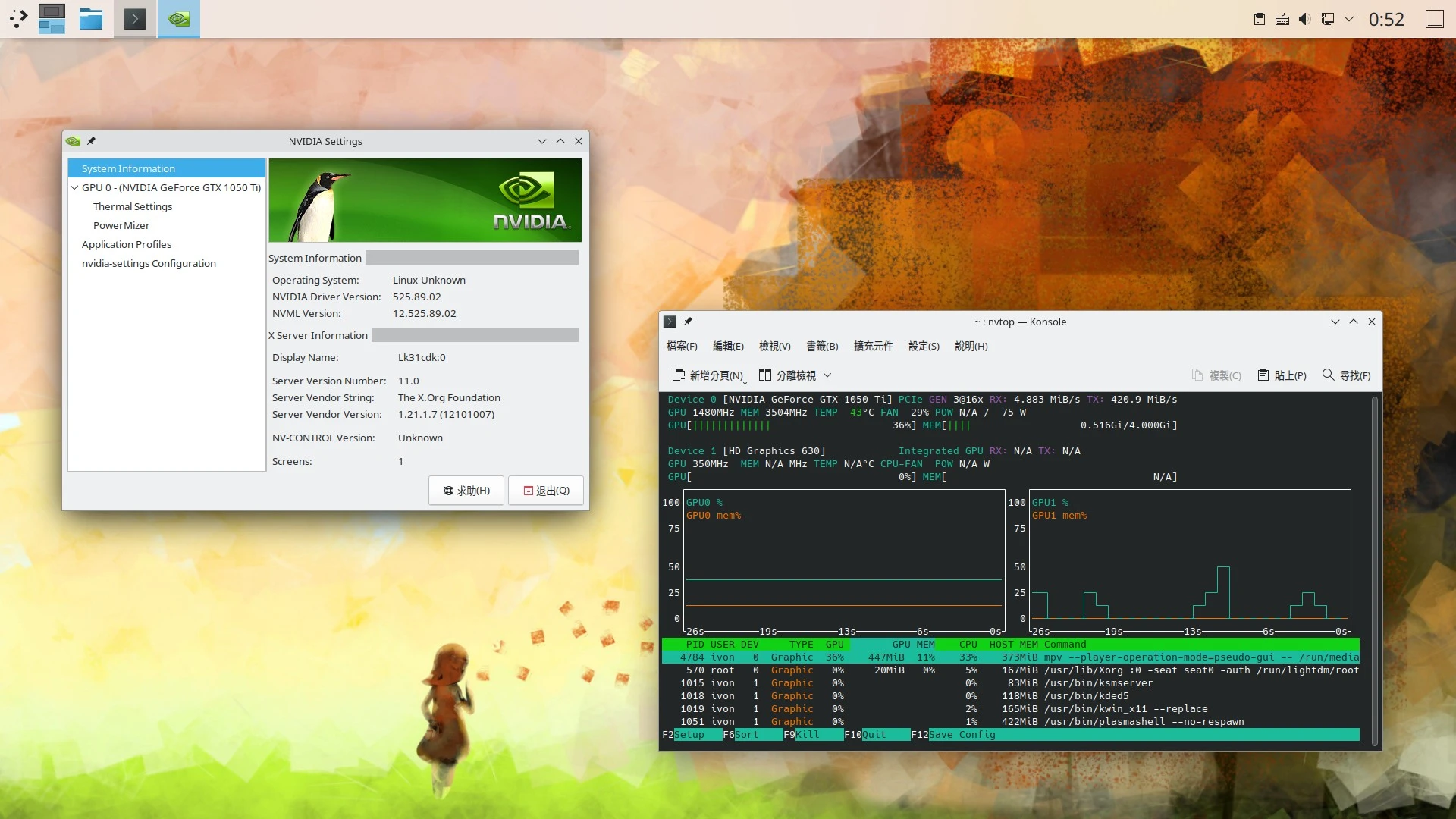
In fact, I betrayed the free software ideology mentioned at the beginning of the article.
At present, what I want to pursue is a system philosophy that takes both humanity and hackers into account, giving equal weight to graphics and commands, seeking to maintain user freedom while allowing more people to use Linux. Therefore, I do not reject using some proprietary software, whether hardware or software. But in the big picture, I still encourage Linux users to seek free and open source solutions. For example: with GIMP and Krita, there is no need to go to great lengths to run Photoshop with Wine; everyone should learn LibreOffice and Kdenlive to replace common but functionally basic proprietary software; Taiwan’s educational sites should use more free software.
But no matter how much I compromise, my bottom line is that the system I use still has to be Linux, so in the end I returned to Arch Linux. This is purely a personal choice. It has no fancy packaging, no large company interfering with its development direction, no system settings forced down users’ throats, and enough users to keep the system popular. As mentioned earlier, encountering Debian gave me a clearer concept of system maintenance, so when installing Arch, including the tutorial that is still being updated now, I try to arrange the system according to the best practices written in the Wiki. In the future, I will be more cautious when installing AUR software, and use Flatpak and Docker more often to install software. In summary, I use Arch Linux to pursue the latest technology, while also avoiding an overly radical attitude affecting life.
Finally, on the issue of promoting Linux, in terms of distributions, I still recommend that beginners try Ubuntu first. There is nothing else. No matter what drama Canonical has, Ubuntu is almost already the Linux standard for enterprises and personal computer desktops, and it has many users. As long as they still observe the bottom line of free software, there is no need for brainless boycotts. Related article category: Linux Tips
It is not too late for users to try other Linux distributions after they are truly interested. People who love freedom more are welcome to learn Arch Linux.
In terms of desktop environments, I cannot accept overly geeky desktop environments, such as dwm, i3WM, and Sway. Those would have the opposite effect when promoting Linux.
In addition, after testing several times, I personally still think GNOME is hard to use. XFCE is too crude, and Cinnamon’s defaults are ugly, so to this day I only recognize KDE Plasma as the best Linux desktop. Someone complained to me that it looks like a toy? That it is unstable? That too many adjustable settings make it complicated? I do not think any of these are problems. KDE still has higher freedom; stability has also improved a lot in recent years; KDE integrating command-line operations into graphical system settings is not useless, but a setting that makes the system easier to use.
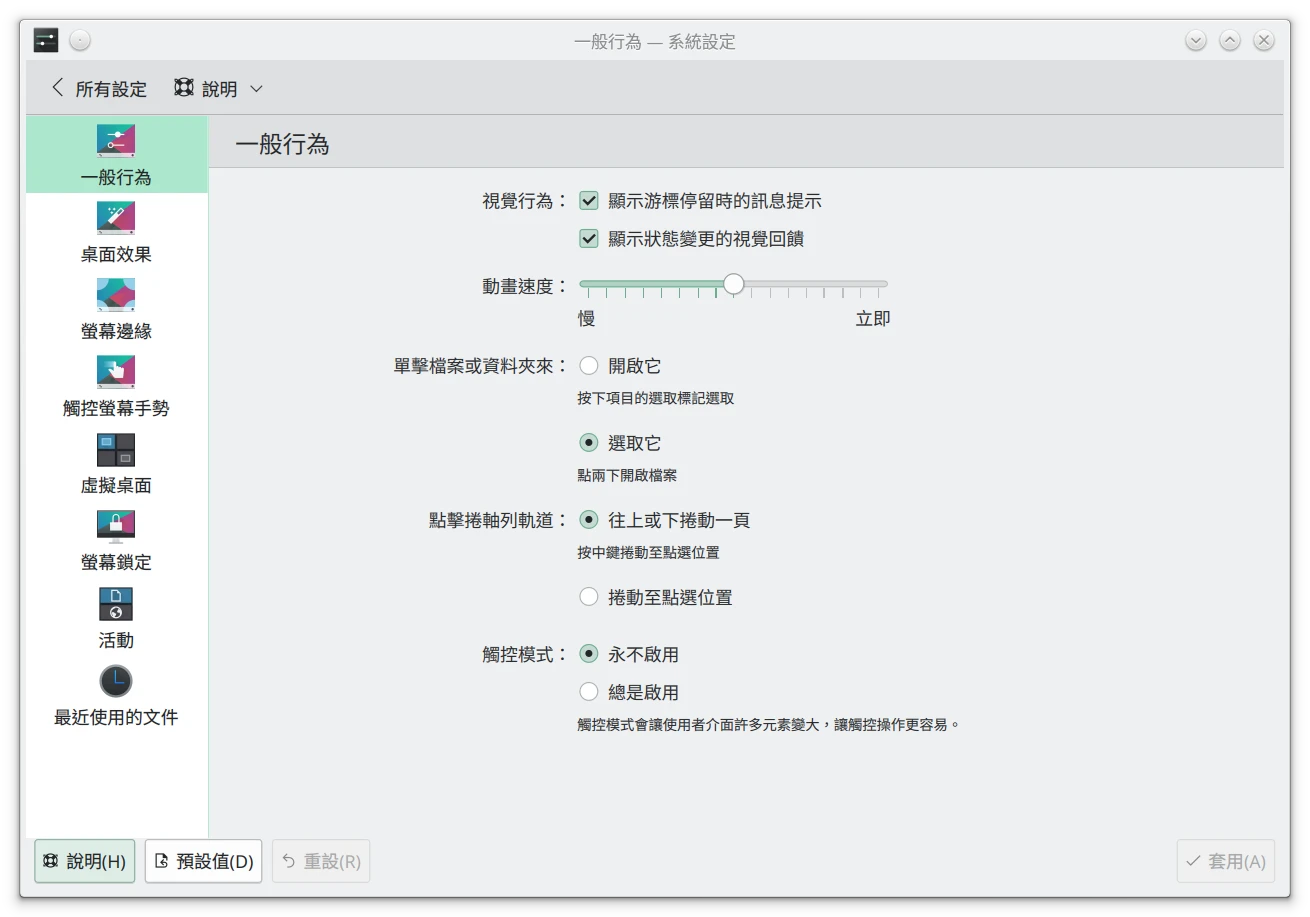
With Arch Linux and KDE, writing Linux promotion tutorials now has a solid platform for demonstrations. However, considering the difficulty of getting started for the general public, the examples I use for external teaching are still mainly Ubuntu installation methods (virtual machines are so useful). Only when I have spare capacity do I list Ubuntu and Arch Linux installation commands side by side.
Thanks to the efforts and contributions of all developers in the world, we have the free software and Linux ecosystem.
Now I am settled in Arch Linux. In the future, perhaps I will continue to embark on the path of exploring more Linux distributions.
「ここにはボクがいて そこにキミがいる それだけで 明日がかわるから」
I am here, and you are there. Just because of that, tomorrow will change.