Can Anime and Manga Works Be Open Sourced? Examples of Applying Creative Commons Licenses to Artistic Creation.
Disclaimer: I am not a professional lawyer. If you need to discuss formal legal issues, please consult a real lawyer.
Creative Commons licenses (Creative Commons CC) are a series of license terms regulating the sharing of online materials, giving creators guidelines to follow when allowing the public to access their works.
The free software movement has developed for 30 years and produced the famous GNU GPL license. Getting program code open sourced is not difficult, but what about open sourcing one’s own “artistic” works? Can anime, manga, games, and music works also be “open sourced”?
1. Free Software License Terms and Creative Commons #
First, we need to understand license terms that protect our rights and interests: the difference between free software license terms and Creative Commons.
The Copyright Act of the Republic of China provides:
Copyright arises from the date a work is completed.
The Taiwan Creative Commons Project explains:
This is “All Rights Reserved.” For any use beyond “fair use,” users must obtain authorization from the copyright holder in advance.
Therefore, creators choosing suitable license terms themselves allows creators to set conditions autonomously and avoid needless copyright disputes.
Free and open source license terms are mostly used for software, and their shared spirit is open source code. Among them, GNU GPL is the strictest:
Users can freely obtain the program source code, modify it, and distribute it. After modification and use, they must also release the source code, achieving the purpose of mutual benefit.
Creative Commons, by contrast, is where authors proactively declare certain powers for others to modify and use their works. The Taiwan Creative Commons official website provides six license terms that are simple and easy to understand. Their common point is “attribution,” and implementation details should refer to each license’s full text.
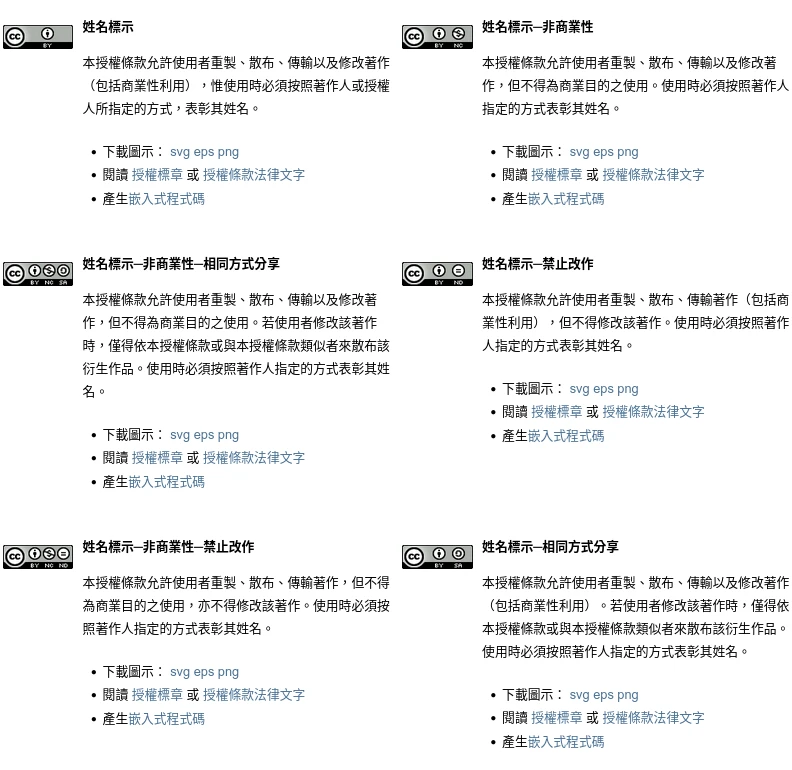
The image above includes terms such as “Attribution”: it allows users to reproduce, distribute, transmit, and modify the work, including commercial use, as long as the original author’s name is credited.
Another example is “Attribution-NonCommercial-NoDerivatives”: it allows users to reproduce, distribute, and transmit the work, but not use it for commercial purposes, nor modify the work. When using it, users must attribute the author in the manner specified by the author.
There is even “public domain dedication”: CC0 provides a “no rights reserved” licensing option, allowing rights holders to choose not to be protected by copyright and database-related laws, and not to enjoy the exclusive rights that the law directly provides to creators.
When declaring and marking Creative Commons, it is best to write it out completely, for example:
Attribution-NonCommercial-ShareAlike 3.0 Taiwan (CC BY-NC-SA 3.0 TW)
But sometimes it is simplified, such as:
CC BY-NC-SA 3.0
At this point, as long as you attach a hyperlink to the official Creative Commons website, people who do not understand can click in and read the detailed definition.
Therefore, Creative Commons is suitable for artistic creation, especially when you “hope the work can circulate more widely,” because granting distribution rights also means “translated works” become an acceptable option. You can even decide whether derivative fan works are allowed. To some extent, it is a variation of free software license terms.
Even so, Creative Commons and software licenses are difficult to make compatible, because the two were designed for different forms of works from the beginning. I bring up this comparison here because below we will mention a form that mixes software and artistic creation: games.
2. Examples of Creative Commons Artistic Works #
When it comes to artistic works, the best examples of Creative Commons are music, such as free music libraries on Youtube that let others use their works as background music to build recognition. Besides that, many photos, videos, novels, and books use Creative Commons licenses, allowing people to easily adopt them as materials. Google can even filter for images that use Creative Commons.
As for anime and manga, if we talk broadly about animation, there are many animated works from around the world. For example, the Blender Foundation’s animation Big Buck Bunny uses the Creative Commons Attribution license (reuse allowed). As a result, many open source video players use this animation as a demo video.
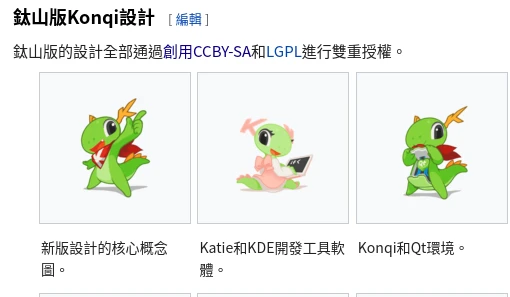
Painting and manga works are much rarer. Among painting works, mascots more commonly use Creative Commons, such as Konqi, the KDE desktop mascot, which uses dual licensing under CC BY-SA and LGPL.
As for comics, because comics are not simply designing one character, but require creating a complete plot and worldview, and can even be adapted into animation, it is genuinely not easy. At present, a comic work that did not enter the public domain due to age and used a CC license from the start is Pepper & Carrot. The author released it under the CC BY 4.0 license, allowing the online community to participate in translation.
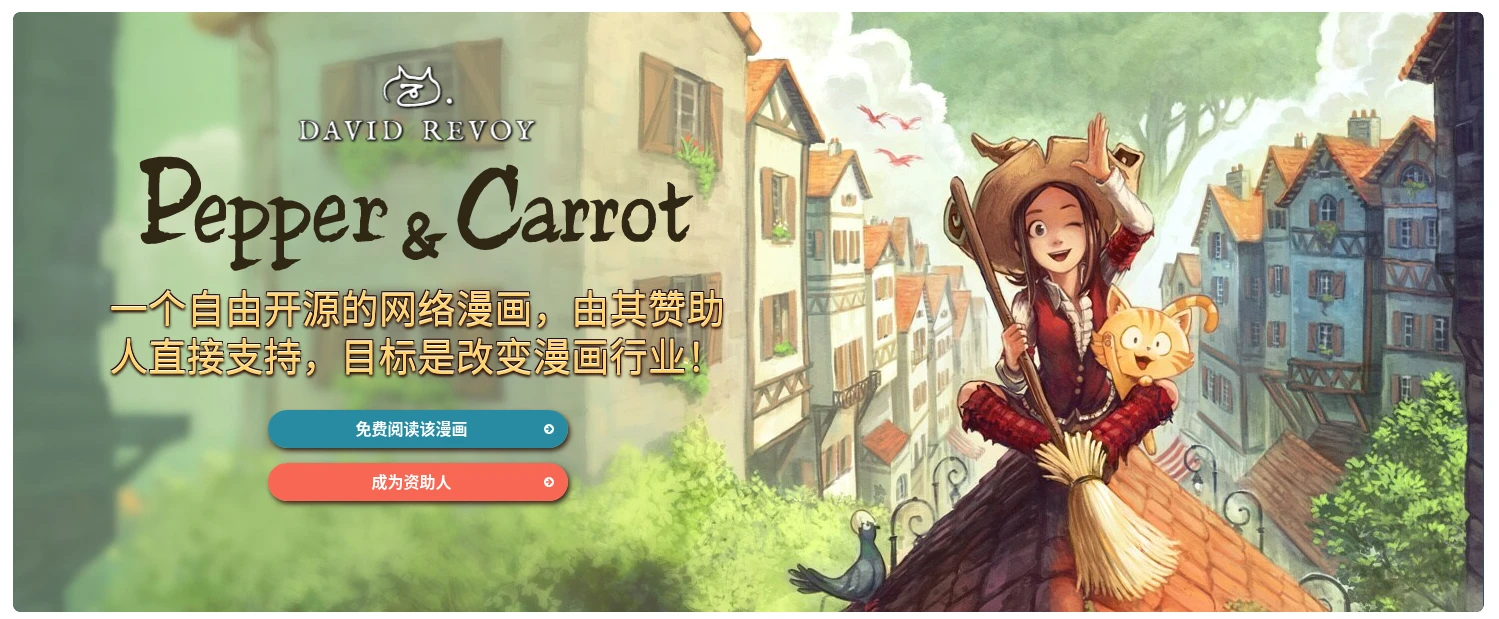
Its derivative animation is released under the CC-BY-SA 4.0 license.
Games can be divided into two parts. The program code may use free software license terms, while the game art assets use Creative Commons licenses. For example, the 0.A.D game engine is licensed under GPL, while the art assets are CC-BY-SA.
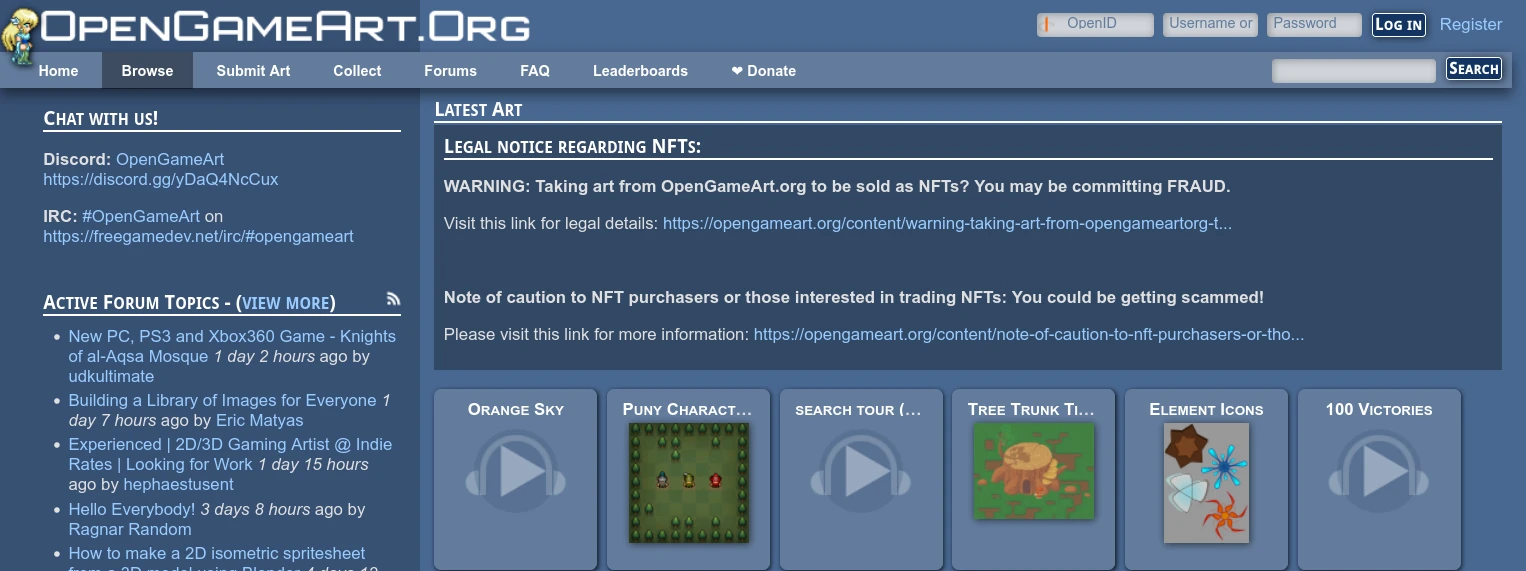
The free game asset website “OpenGameArt” releases its works under Creative Commons.
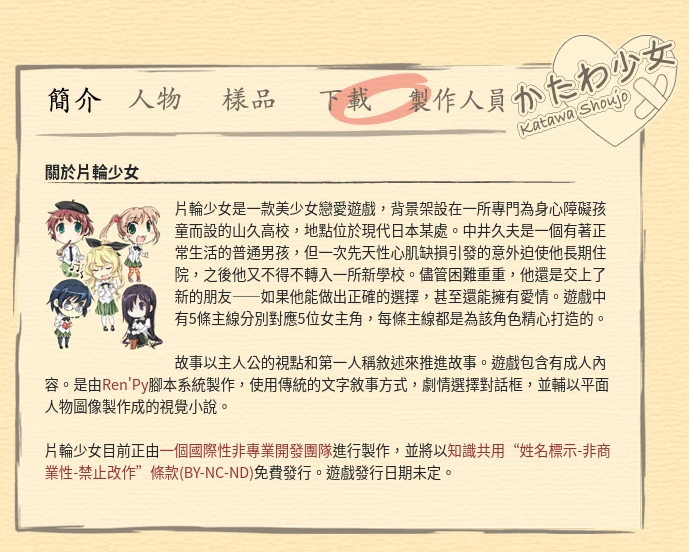
Another example is the GalGame Katawa Shoujo, whose assets are licensed under Attribution-NonCommercial-NoDerivatives, but Katawa Shoujo has not released its source code. Please note that a “free-of-charge” game does not mean it is free software. Even if the software can be freely obtained and distributed, a game that does not release source code is still nonfree software. Creative Commons also has no power to require authors to “release source code.”
3. Do Creative Commons Works Allow Doujin Derivative Works? #
Creative Commons has a sharing nature? Then can I just freely use it to make doujin derivative works?
Doujin works, also called derivative works, are regulated by the copyrighted original work. At this point, it depends on which CC license the author chose.
If the license terms include “NoDerivatives,” then of course you cannot create doujin works based on it.
By contrast, if there is “no NoDerivatives,” then naturally you can use it freely. If the original author wants to avoid merchants abusing their work, adding “NonCommercial” is a better choice.
In countries that obey the law, choosing clear and appropriate license terms can effectively protect the rights to our works and avoid vague licensing problems.
4. Can Works Using Creative Commons Make Money? #
Here we need to understand one concept: Creative Commons does not mean authors cannot make money. Authors can still open a Patreon or publish a book. Likewise, if the terms do not restrict commercial use, there is nothing wrong with commercializing the work.
The author of Pepper & Carrot believes that people should not pay to obtain exclusive works; opening a Patreon is only for sponsoring the project.
Even though all copies of Pepper & Carrot can be obtained online for free, publishers in various countries have still published it as physical paper books.
5. If Someone Violates a Creative Commons License #
Creative Commons licenses are generally permanent, and creators do not have the power to unilaterally change them retroactively. Some CC licenses state that when redistributing, stricter terms may not be added as restrictions.
So if you encounter a situation that violates the creator’s rules, according to the Taiwan Creative Commons Project:
If a user violates the requirements of your license terms, this license and the rights it grants will automatically terminate. For this user who does not comply with the license conditions, this work will revert to an all-rights-reserved copyright status. In other words, it returns to the legal procedure for infringement under current copyright law.
Creative Commons can sometimes be seen as a moral guideline. If profit-seeking people violate the rules set by the author, the author still has the right to file a copyright complaint. But Creative Commons is not responsible for protecting copyright:
Creative Commons will not bear any liability for damages to you or other parties as a matter of legal principle.
6. Conclusion #
Like the free software movement, Creative Commons should not force people to join. But Creative Commons is likewise a way to promote the public interest. People can freely use creations within the rules, and it carries the ideas of sharing and not forgetting attribution.
References #
- 許可證- GNU 工程- 自由軟體基金會(FSF)
- 台灣創用CC計畫| Creative Commons Taiwan
- Frequently Asked Questions - Creative Commons
First draft: May 30, 2022.