There are really too many losing Wayland compositors! Sometimes when I see someone using a WM instead of a DE, I think they are pretty impressive, but this is very hard to popularize. Not to mention there are even people teaching students in class to install IceWM. Is Linux desktop fragmentation still not serious enough?
Every time I see a new Wayland compositor appear, be like:

Do you not think so? After the Linux desktop gradually migrated to Wayland, at least more than 20 Wayland compositors have already appeared. Besides the better-known Weston (Wayland’s official reference implementation), GNOME Mutter, and KDE Kwin, there are also a whole bunch of Wayland compositors developed based on the wlroots or Smithay libraries, such as Hyprland, WayFire, Niri, Labwc, River, dwl, Hikari, Miracle……and so on. Many of them cannot even constitute a Desktop Environment; they are just compositors, and you have to find other components yourself to assemble a desktop.
This inevitably makes people think of the glorious scene of the many X window managers in the X Window era. Users of different X11 desktop environments could switch the Window Manager and Compositor to achieve the window effects they wanted. There were at least more than 20 X window managers. However, times have changed. Wayland desktop users should not replace the window manager alone. Either replace the entire desktop environment.
Although the following image is slandering Wayland, it explains very well the role Wayland compositors are now supposed to play. The architecture is simply different from X Window. Therefore, creating multiple Wayland compositors appears unnecessary.
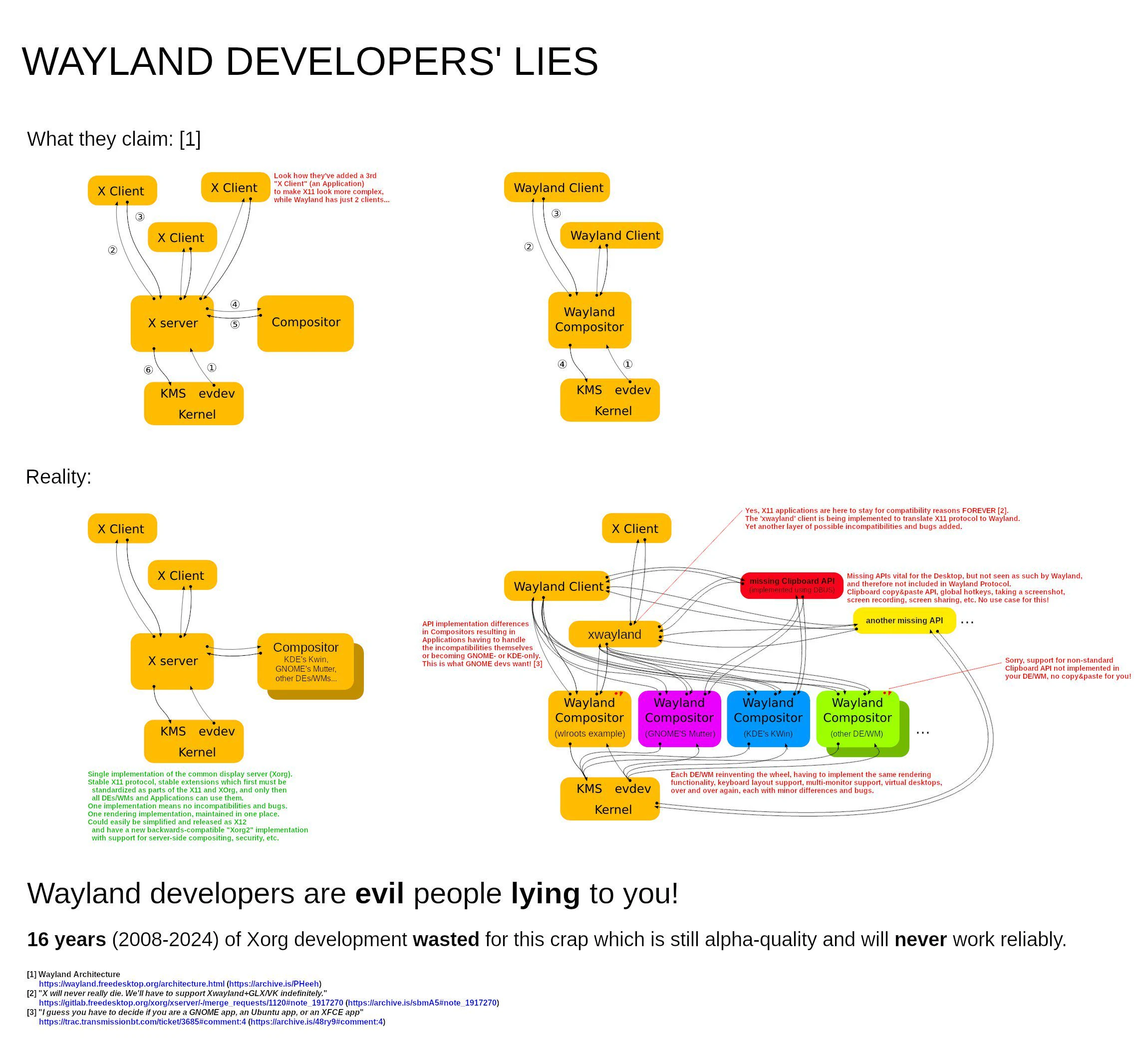
Hyprland author Vaxry discussed this issue in We don’t need more Wayland Compositors. He pointed out that Wayland’s structure is different from X11’s. Because there is no unified X Server now, Wayland only has a set of standard specifications, and it must rely on compositor implementations. Today’s Wayland compositors are responsible for far more than X window managers were. Besides arranging windows, every Wayland compositor also has to handle complex operations such as screen recording and interaction with graphics drivers.
So after many Wayland desktops mature, they will have their own XDG Desktop Portal, so they can implement the common standards defined by FreeDesktop. If you want the kind of simple mechanism and configuration that dwm had in the X11 era, Wayland has already made that very hard. Even Sway, which advertises itself as imitating i3wm, has to develop its own XDG Desktop Portal.
He believes many Wayland compositors are reinventing the wheel, using different code to implement almost the same functions. Some projects may end up buried in the sand before long, and may even have trouble opening a terminal.
If I were to put it more extremely, there are only two desktops in the Linux world worth making serious efforts to improve: GNOME and KDE Plasma. Other desktop environments are not as important as they are.
In the end…the solution proposed by Hyprland’s author is that everyone should just develop based on a small number of desktops as a baseline. For example, develop plugins around Hyprland, allowing users to modify Hyprland’s window arrangement method and replace the role once played by X Window Manager. Instead of writing a pile of Wayland compositors from scratch. But well, Hyprland is written in C++, which does not satisfy some people’s fetish for Rust’s future.
By the way, Hyprland’s author is not interested in System76’s COSMIC desktop: The problems and shortcomings of Cosmic He thinks this desktop lacks a clear development direction and does not know who its target audience is.
Lmao, Hyprland itself does not count as a desktop environment at all, and it still targets advanced users, www. Hyprland is not a complete desktop, but it still has to develop related tools itself, such as the wallpaper program Hyprpaper, to complete the desktop experience. In the end, compositors like Hyprland are still reinventing the wheel.
Personally, I feel that…modern desktop environments are too complex. Although open source itself is prone to fragmentation, people should focus on developing a complete desktop experience, at least taking COSMIC as an example, striving to provide a complete product rather than only a compositor. Or contribute to existing desktops. Unless it is something developed for special scenario needs like Steam Gamescope and Purism Phosh, other standalone Wayland compositors do not seem to have much value for ordinary users. Just leave them to the geeks who love exploring.