A stern rebuttal of concept switching:
When discussing the issue of few people using Linux, some people will claim the following:
“Few people use Linux? Actually lots of people use Linux, you just do not know it. Your phone and servers are all relatives of Linux blah blah blah”
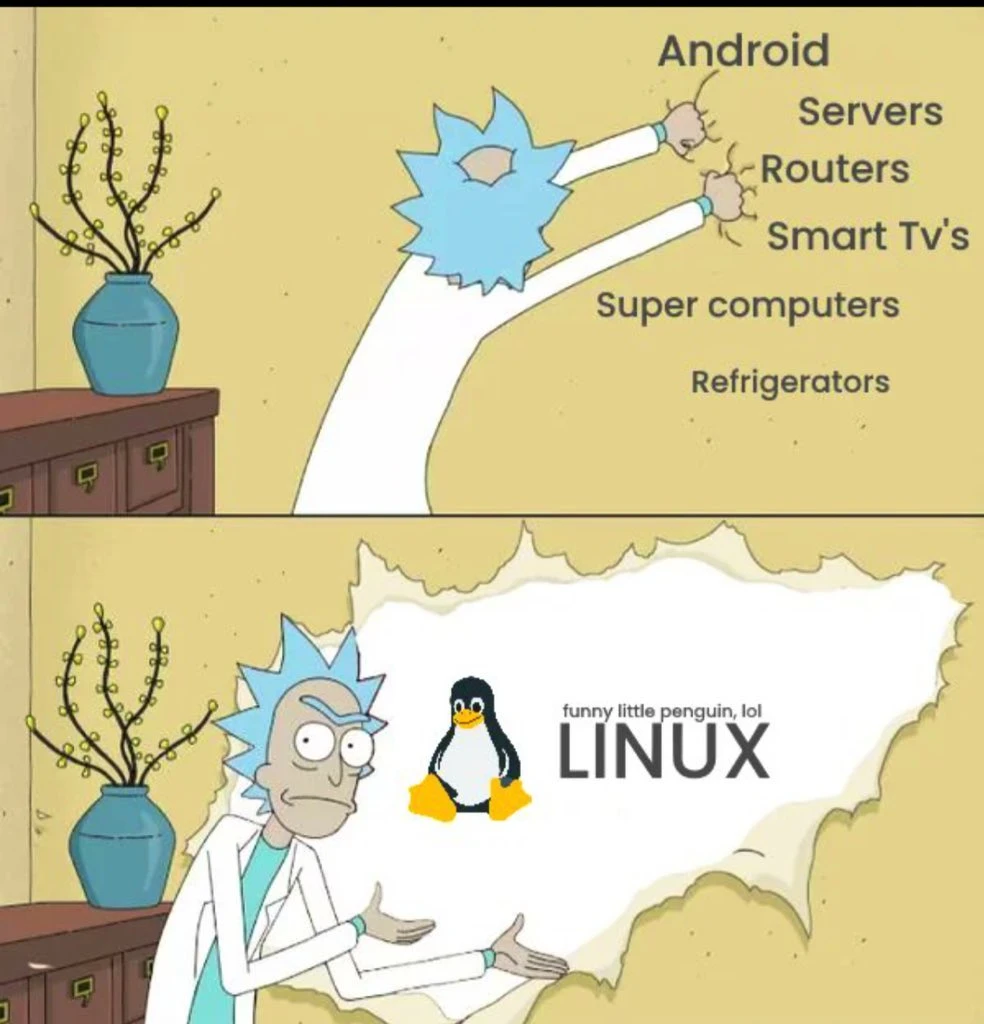
Have you noticed that when you say this, the topic suddenly becomes grand and elevated? Ahh, so many devices around us are Linux, you and I both live in a gigantic open source world, we are part of the universe……No! What we are talking about now is personal computer desktop systems!
There is a problem with this kind of argument: “switching concepts”.
You do not directly use the “Linux kernel”. Linux needs to be packaged with a set of tools into a distribution before it can be used, and this is usually called GNU/Linux. Also, not every system that has a little bit of connection to Linux can count as GNU/Linux.
When a speaker mentions computers, what ordinary people understand is desktop computers, meaning the Windows and macOS personal computer market. And Linux of course refers to GNU/Linux Desktop-oriented distributions (Ubuntu, Fedora, openSUSE, Arch Linux, Gentoo), which usually include the GNU toolchain, use X.Org or Wayland as the graphical interface, follow XDG standards, respect user freedom, and are not other systems based on the Linux kernel.
In a broad sense, Android counts as a Linux distribution, but you clearly know Android cannot be used on computers (at least before Android 16, it is still not mature enough), and its graphical protocol and system tools differ greatly from the Linux desktop. Even the standard C library is incompatible. The same goes for ChromeOS. It cannot really count as a Linux desktop distribution. Its system base is almost not the GNU toolchain, and its upper-level graphical protocol is still a heavily modified Wayland.
Other Linux machines go without saying. You do not call a “server” a “personal computer”; this kind of computer does not even have a monitor (in most cases)!
As for game consoles. Even if a Playstation can run Linux after modification, few people would treat it as a computer. Some open source handhelds can be said to use Linux distributions, but they do not count as personal computers. As for Steam Machine? Let the bullet fly for a few more years; this is only the beginning. I am optimistic about it rising to become a kind of personal computer alternative, but not yet.
According to the above definition, it is correct that few people use the GNU/Linux desktop, and this is a fact that cannot be avoided. According to StatCounter, the GNU/Linux desktop share is only about 4%.
If you forcibly count systems such as ChromeOS, Android, and SteamOS as Linux, the ratio may be much higher, but that is super concept switching.
Forcibly taking credit for yourself! Shameless!
According to my definition above of GNU/Linux Desktop distributions, I think that among the various systems based on the Linux kernel, only SteamOS has the structure closest to an ordinary GNU/Linux Desktop distribution (immutable Arch Linux), while also being capable of succeeding in the general personal computer market. However, its development has only just begun, there is not much hardware, and whether it can sell more than the Chromebooks Google dumps into the education market in bulk still needs time to observe.
Even though the Linux kernel is a global project inseparable from the open source community, systems that use Linux even a little should probably deserve community praise too. However, we cannot allow boundaries to be blurred when making statements.
For example, even though macOS and Linux were both influenced by Unix, we do not say they are that super awesome Unix from the 1980s. macOS now even restricts user freedom in return. Think different? has become Think same!
The advantages of GNU/Linux are not determined by scale alone. Next time you want to emphasize the advantages of GNU/Linux, stop using this concept switch. Linux may seem omnipotent in every field, able to drive electricity and go to space, but for ordinary users, they will only ask you one thing: so how am I supposed to type a Word report? They will even complain that LibreOffice, which liberates users from bondage, is hard to use!