Can a Linux Desktop Distribution Really Be Both Latest and Stable? Starting From Migrating From KDE Neon to Debian.
Is there a Linux distro with latest and stable Plasma desktop?
I have had enough.
Everything around me is full of things I cannot control. At least let me have absolute control here!

Recently, the KDE Plasma desktops on both of my computers (KDE Neon/Ubuntu & Fedora) have been in a very unstable state, so I started thinking it was time to return to a stable system. Recommended KDE Plasma Linux distribution? I think my answer now is Debian.
I know, I know I have let you down. (Komm Süsser Tod)
1. Beginning #
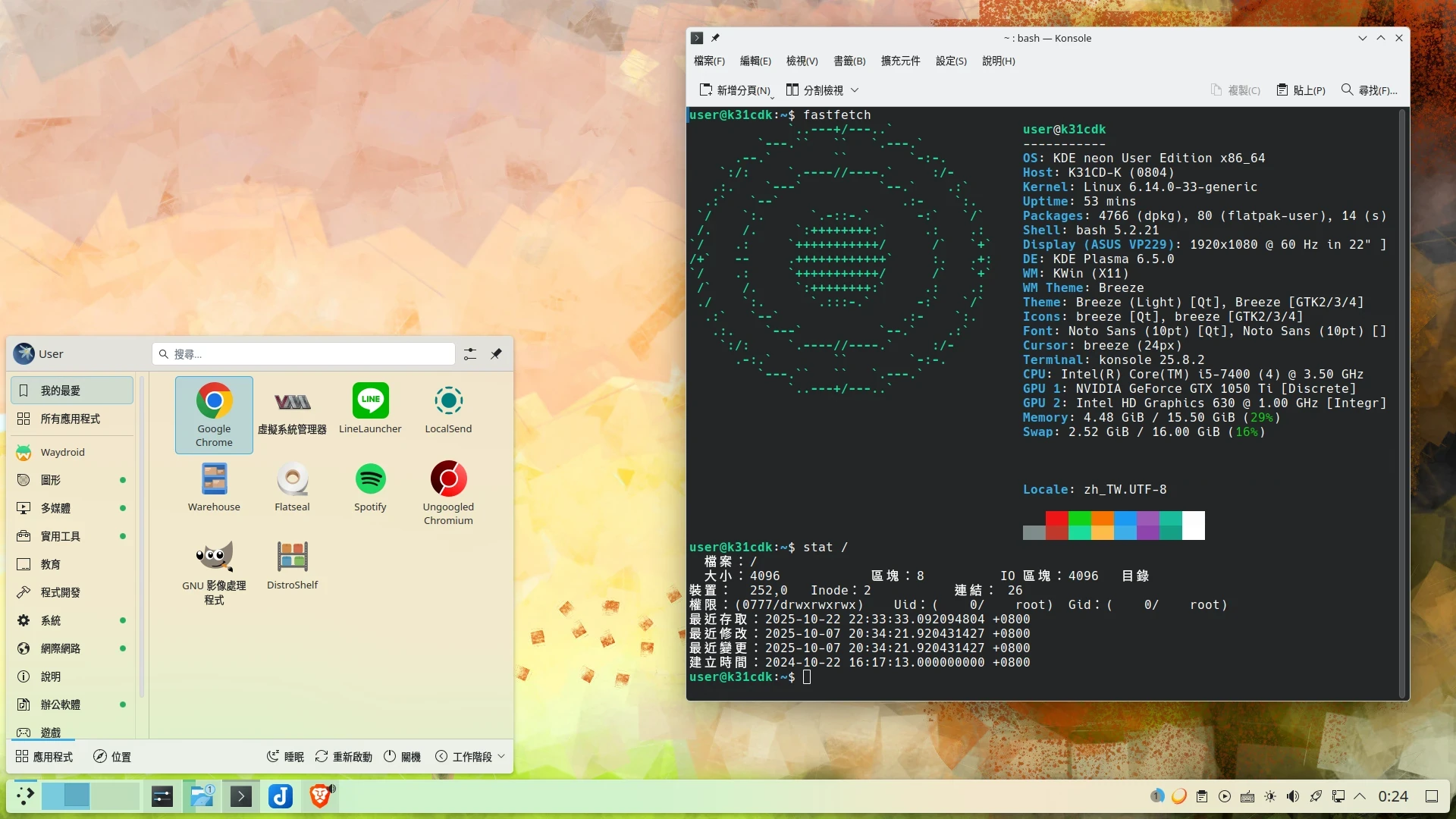
My desktop used to be KDE Neon (converted from a Kubuntu installation using PPA). Because it is rolling-updated, a KDE minor version may last only one month, and then a new version appears the next month. On top of that, I update the system once a week, so I always receive the latest updates. But this frequent update speed simply cannot ensure stability. Maybe KDE 6.4 finally becomes relatively stable, then it updates to KDE 6.5, and then a pile of programs cannot open. This repeats over and over, in a process of constant fear.
Finally, I replaced this fake Ubuntu system that had been installed for a full year with Debian.
On the other hand, I switched my laptop, which had Fedora Workstation installed for six months, to Fedora Kinoite and continued using it after reinstalling. This system partition remains unchanged, so I should have a hard time breaking the system, right? Compared with uBlue Aurora, Fedora Kinoite installs fewer things by default and requires manually adding a pile of overlays.
Oh~ toolbox is more capable than I thought. toolbox (Toolbx) is a tool specifically for running Linux containers, where traditional DNF can be used to install software. Since rpm-ostree is so troublesome, why not stuff everything in here? It can actually run ADB inside. As for when to use rpm-ostree, it is really slow. Even installing a simple small package, even with apply live, takes a long time, because everything has to be rebuilt. Although command-line tools should be operated inside toolbx, I really am not used to this containerized development that cuts off both arms.
Although the system is immutable, that does not guarantee stability. KDE still randomly crashes. This repeats over and over, often in a process of constant fear.
In the end, I changed that to Debian too, temporarily giving up on rolling-release distributions.
2. The Contradiction Between Latest and Most Stable #
In the past, I thought “I use Arch btw”; this sentence also applies to other rolling-release versions, but… so? Pursuing the latest Linux software is great, but how do they ensure system stability?
KDE is very unstable on rolling-release distributions, both Arch and Fedora. Some people will say rolling releases have rollback mechanisms, so there is no need to worry if rolling updates break. But if the system is viewed as a “whole”, Linux has a hard time separating users’ software from the system’s software, which causes rollback trouble. When the system has problems after an upgrade, exactly which packages will be downgraded?
This is only my hypothesis: using a rolling Linux distribution with a complex desktop environment, such as KDE, makes the degree of system instability proportional to software complexity. This creates a driving force that causes users to gradually adopt a “minimalist approach” desktop environment, such as Sway, choosing to assemble what they need themselves and becoming command-line fanatics. Now you know why there are so many lovers of TUI programs.
But this is also easily refuted by personal experience: some people say they have used Arch Linux with KDE for five years and nothing happened!
But for me personally, I observed many graphical glitches within just one year. I want to experience the latest KDE and also have a stable system. This is fundamentally impossible to reconcile, and even KDE Neon has many problems.
It is impossible for me to use GNOME…むりむりむりむりむりむりむりむりむり. This anti-human design and environment unfriendly to QT programs is unacceptable no matter how I think about it. In addition, I need to avoid Nvidia screen tearing problems, so it is impossible to go back to an X11 desktop. I am not very interested in tiling Wayland compositors that require tinkering.
3. Maybe I Should Look at Immutable Distros #
I think the possible solution for rolling-release distributions with KDE is to use an immutable distro, keeping the system unchanged to enhance long-term stability and avoiding users breaking system stability by installing packages themselves.
Just as LineageOS is a rolling release, but Android’s read-only nature prevents it from being randomly modified by users. But looking at current immutable distros, especially Fedora-based ones, what they actually solve is not that important. They focus on system rollback capability, containerization, and ensuring update-time stability through atomic updates.
But the one thing they do not guarantee is stability itself. Because I do not believe Fedora’s update model is necessarily more stable than Debian’s. Apart from SteamOS, no open-source team can ensure an immutable KDE desktop is released only after testing has proven it stable, with all necessary drivers installed. Often users still have to install some packages themselves.
In other words, we lack an immutable distro whose selling point is LTS. My current candidates are Vanilla OS and HeliumOS.
CentOS Stream may not be as bad as imagined. On the contrary, in some sense it is very similar to Ubuntu LTS, except its updates are a bit faster (<- incoherent statement?). The series of Bluefin distributions launched by the uBlue OS project makes my head spin. But I saw someone on Threads constantly recommending this distribution, so I read some research reports and reached the following conclusion. Basically, Bluefin is an enhanced Fedora Atomic, focused on low-maintenance and containers, maintaining an immutable model and using bootc and rpm-ostree to manage the system, while providing various images for different purposes, such as Bazzite for gaming, Bluefin for the GNOME desktop, Aurora for the KDE desktop, and so on.
In addition, there is Bluefin LTS based on CentOS Stream (GNOME desktop + HWE kernel), and HeliumOS based on Alma Linux (KDE desktop). These latter two are quite interesting. Many immutable distros on the market are almost all modified from rolling releases. Although they say failed upgrades can be rolled back freely, that is fundamentally not stable, especially for KDE desktop users.
I still prefer systems with slower updates like Ubuntu LTS. In addition, I do not want a stable system to become chaotic due to installing software myself plus the law of entropy increase. At such times, immutable distros become useful.
By the way, although CentOS Stream is no longer the point-release distribution beloved by freeloaders, it has not stopped development, and it also does not really resemble a true rolling-release distribution. Like RHEL, it still has version numbers. Since its development progress is slower than Fedora’s, and each version has a maintenance period as long as five years, understanding it as Fedora LTS is not impossible. It is still properly maintained, so RHEL can safely accept changes. Of course, whether the Linux community is interested in it is another matter.
4. Is There Really a System You Can Use for a Lifetime? #
A system you never have to change for a lifetime…

Unless it is a server silently working in a machine room, like RHEL with a support cycle as long as 10 years, it simply cannot resist the temptation of distro-hopping! But even when distro-hopping, I want to be a normal human being, able to use things steadily, rather than worrying that something will break after an update in a month, a week, or even tomorrow.
In the past I really believed that “rolling-release distributions” had no version numbers, required no major version upgrades, and could be used for a lifetime. But the more they rolled, the less confidence I had. Arch, openSUSE Tumbleweed, Fedora, and my beloved KDE desktop all encountered problems one after another. Within one year, KDE package versions kept updating, increasing instability. Even immutable distros only allow rollback and do not guarantee stability. Therefore, I decided to obediently use stable-release distributions again. Let longer development cycles, let time dilute the bugs. KDE provided by Debian, Ubuntu, Rocky, and Alma is less likely to crash after updates. Major version upgrades average once every two years, and within that cycle there will not be major changes; desktop package versions almost do not change.
Truly I tell you, do not worry about tomorrow, for tomorrow will worry about itself. Each day has enough trouble of its own.
5. I Am Numb, Just Switch to Debian #
With no hindrance in the mind, and because there is no hindrance, there is no fear; far from inverted dreams, ultimately Nirvana. Welcome home, back into the embrace of point-to-release. Not only the system, but desktop packages too should not use a rolling-release model. Abandon rolling-release distributions with KDE, and do not use KDE Neon either.
I really cannot tolerate rolling-release distributions anymore. For a long time, I have tested rolling-release distributions on secondary computers. But when I need to use them temporarily, updating the system can easily throw it into an unstable state, which is very agitating.
I do not want to stay in a process of constantly worrying about change anymore. Everything around me is full of things I cannot control. At least… let me have absolute control here!
In short, I do not like rolling-release distributions. So recently I returned to using stable-release distributions and chose Debian 13 with KDE 6.3. Although I know this version of KDE Wayland still has a small chance of crashing, it is foreseeable that no more unknown bugs will appear in the next two years.
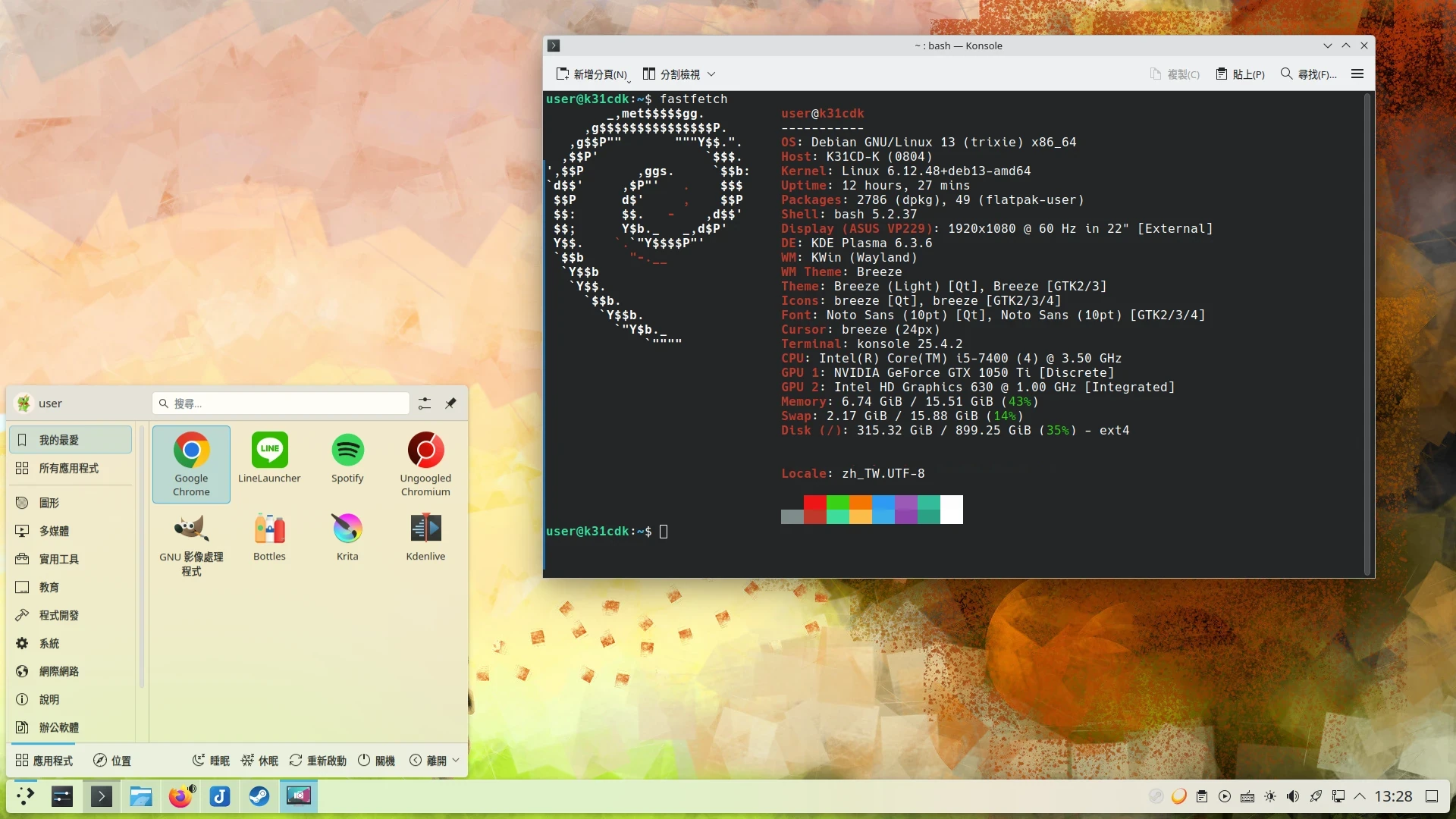
Recently I finally realized the fact that Debian Stable’s KDE version is updated one year faster than Kubuntu LTS. Look at Debian 13’s KDE 6.3 compared with Kubuntu’s KDE 5.27, and it is also more stable than KDE Neon… maybe it is coincidence.
Ahh, and so I fully switched the systems in my hands.
Jesus Bleibet Meine Freude